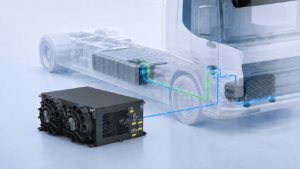
A practical RFQ checklist for electric bus and truck teams specifying a high-voltage coolant heater, with required inputs and supplier confirmations.
A high-voltage coolant heater RFQ needs more than a voltage and power label. Two heaters with similar headline ratings may have different operating windows, coolant-side losses, connectors, control interfaces and test conditions. If those details are missing, suppliers cannot quote against the same requirement. Use this checklist to prepare a reviewable request for an electric bus or truck project—and mark unknown items as open questions instead of guessing.
Start with the vehicle duty, not a heater model
Tell the supplier whether the heater serves a battery loop, a cabin loop or both. Describe the operating event that matters: an overnight cold soak, a scheduled departure, a charging stop, defrosting, or a combination. Record the ambient and coolant conditions at the start of that event, the target condition and the available time. If the heat demand has not been calculated, say so and ask what vehicle data the supplier needs to help evaluate it.
A requested 30 kW, for example, is not a complete thermal requirement. The buyer should define where that power is measured, at what high-voltage supply, coolant inlet temperature and flow, and whether the value is continuous or required for a short operating window. Do not treat a series-wide power range as proof that every configuration delivers a selected output under every condition.
Put these eight items in the RFQ
| Buyer input |
What to provide |
What the supplier should confirm |
| Vehicle and heating task |
Vehicle type, loop served, cold-start or charging scenario, target warm-up time |
Whether the proposed configuration is suitable for that duty |
| High-voltage supply |
Nominal, minimum and maximum voltage during relevant operating states |
Permitted operating window, power behavior and shutdown conditions |
| Heat requirement |
Required thermal output, duration, inlet condition and how the demand was derived |
Output evidence at the stated conditions, not only a headline rating |
| Coolant circuit |
Coolant type and concentration, inlet temperature, flow range and available pressure-drop budget |
Compatible fluid, hydraulic data and any minimum-flow condition |
| Mechanical package |
Space envelope, mounting orientation, port positions, hose and service clearances |
Current drawing revision, ports, bracket and installation constraints |
| Electrical and control interface |
Low-voltage supply, connector preference, control owner and required command/feedback signals |
Mating connectors, pinout, communication option and fault response |
| Validation scope |
Project-specific performance, leakage, electrical and environmental acceptance needs |
Available test methods, sample configuration and evidence for the quoted part |
| Commercial program |
Prototype quantity, forecast volume, destination and target milestone dates |
Quotation assumptions, sample scope, lead time and change-control process |
Not every field must be finalized before the first discussion. A useful RFQ distinguishes fixed requirement, supplier proposal and to be confirmed. That prevents an early estimate from being mistaken for an approved product specification.
Ask for a response you can compare
Send the same duty description and revision-controlled attachments to every shortlisted supplier. Ask each one to return a model or configuration identifier, the applicable datasheet revision, a dimensional drawing, an interface definition and a list of deviations from your request. The quotation should state which performance points are supported by existing data and which need prototype validation.
For the coolant circuit, request a pressure-drop curve or measured points over your intended flow range. A nominal flow value alone does not show whether the pump can support the complete loop. If this part of your specification is still open, use the coolant flow and pressure-drop integration guide to define the missing inputs before comparing heaters.
For controls, request the command and feedback list, start-up and stop behavior, timeout handling and fault-state ownership. Do not assume that two products described as “CAN controlled” use the same message set or vehicle-side logic. Agree on the control-interface document before treating a sample as electrically interchangeable.
Use a short project brief for the first enquiry
The following format is deliberately an input template, not an EVLINK model specification. Replace the brackets with your project data; leave unknowns marked as open.
We are evaluating a high-voltage coolant heater for [vehicle/application] in [country/market]. The heater will serve [battery/cabin/shared] coolant loop. Our relevant operating event is [cold start/charging/other], beginning at [ambient and coolant condition], with [target condition] required within [time].
Our HV supply is [nominal] V, with an expected operating range of [minimum–maximum] V. Required heat output is [value and duration] at [stated coolant inlet temperature and flow], or is to be confirmed with engineering. Coolant is [type/concentration]; planned flow is [range]; available heater pressure-drop budget is [value or open].
Packaging drawing revision [number] is attached. Required ports, HV/LV connectors and control interface are [details or open]. Please propose a configuration and identify assumptions, deviations, drawings, performance evidence, sample test scope and quotation lead time. Prototype quantity is [number]; production forecast is [range or unknown].
Three checks before accepting a quoted model
- Match conditions, not only labels. Compare the proposed power at your voltage and coolant conditions. A range shown on a series page is a starting point, not proof for a particular part number.
- Close interface gaps. Check the drawing, mounting, ports, connectors and control document against the vehicle layout. Identify who owns any adapter or software change.
- Define evidence before ordering samples. Agree on the test conditions, measurements, acceptance criteria and reporting format needed to move from a quotation to a vehicle-level decision.
If a standard configuration does not fit the available space, voltage window or control architecture, treat the change as a documented development task. EVLINK’s custom-development process explains how to frame interface and validation work without assuming that every requested change is already available as a released product.
Common RFQ questions
Is nominal vehicle voltage enough to select a heater?
No. Provide the expected minimum and maximum supply during the operating states that matter, and ask the supplier for the proposed configuration’s permitted range and power behavior within it.
Should I request a fixed kW number if my heat load is not calculated?
State the vehicle task and available conditions first. If the load estimate is preliminary, label it as such and ask which input data the supplier needs. Do not present a guessed value as an approved continuous-output requirement.
What makes two heater quotations comparable?
The same vehicle duty, supply window, coolant conditions, interface requirements, sample quantity and acceptance scope. Ask suppliers to list assumptions and deviations separately from the quoted base configuration.
Send a brief that engineering can review
When you have the duty description, electrical window, coolant conditions and available drawings, compare them with the EVLINK high-voltage coolant heater range. If the inputs are incomplete, send the open items anyway and identify their owner. You can contact EVLINK about your heater project with a short brief and the current drawing revision to start a configuration review.