Book Appointment Now


Cold-Weather Battery Preconditioning for Electric Buses and Trucks: What to Define Before Integration
The answer depends on the specific vehicle model, battery type, available power, control strategies, and operational schedule. These conditions should be clearly defined as project requirements before selecting thermal management hardware.
This guide will clarify the issues to consider, who should address them, and how to assess a vehicle’s readiness—never simply assume that a single target temperature or heater rating applies to the entire fleet.
EV Battery Preconditioning and Heater Selection
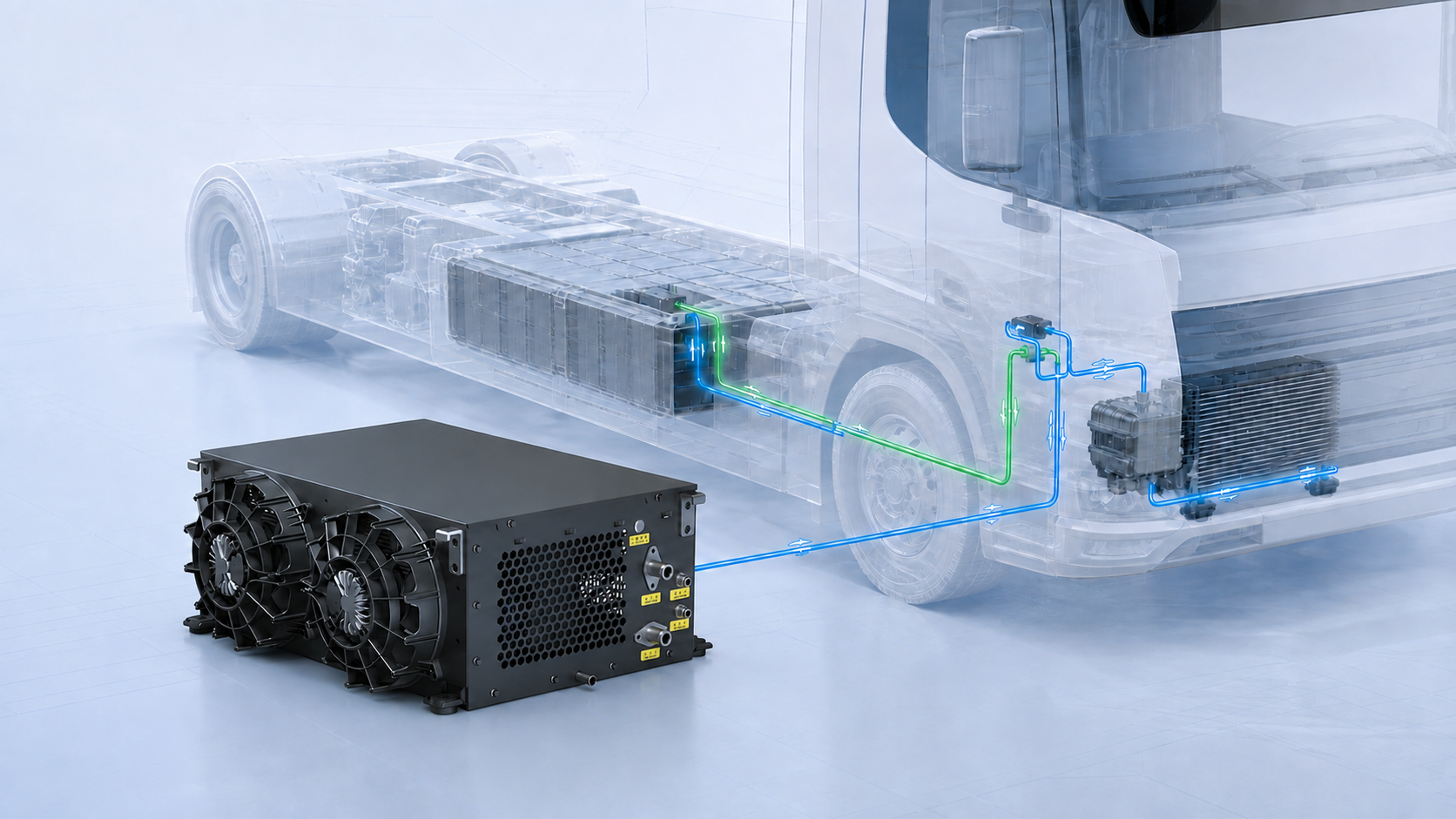
An EV battery heater is selected against the pack temperature target and the time available before departure or charging. Confirm the battery supplier's temperature limits, the available electrical power and which controller enables heating. Compare heater data at the specified voltage, inlet coolant temperature and flow.
Explore battery coolant heaters · Discuss your project
Why Do Batteries in a “Cold Soak” State Complicate Departure Scheduling?
In cold weather, operational planning is both a thermal management issue and a scheduling challenge. The initial state of a battery pack depends on its parking environment and previous operating conditions. Project teams have only a limited time window to prepare vehicles for departure.
Whether a battery can deliver the required power or accept a charge at the time of departure must be assessed based on limits approved by the battery or vehicle manufacturer, rather than by directly applying generic metrics from other projects.
For all-electric buses, the U.S. “Joint Office” recommends giving full consideration to operational requirements in extreme cold weather during planning and discussing battery pre-conditioning strategies with manufacturers. Its guidance on bus operations in cold weather also notes that specific target settings and control interfaces depend on the vehicle and battery supplier.
While these recommendations for buses are relevant to truck projects, they cannot be directly applied as universal standards for the trucking industry.
Analysis should be based on actual operating patterns. Buses may need to depart on schedule after a night of sub-freezing temperatures; trucks, on the other hand, may need to arrive at loading points on time to meet delivery deadlines or recharge after completing specific routes.
In each case, the initial state of the battery, the available preparation time window, and the specific tasks the battery must support should be documented. Compared to broad environmental temperature descriptions such as “winter operations,” these three key elements more clearly define the actual challenges a project faces.
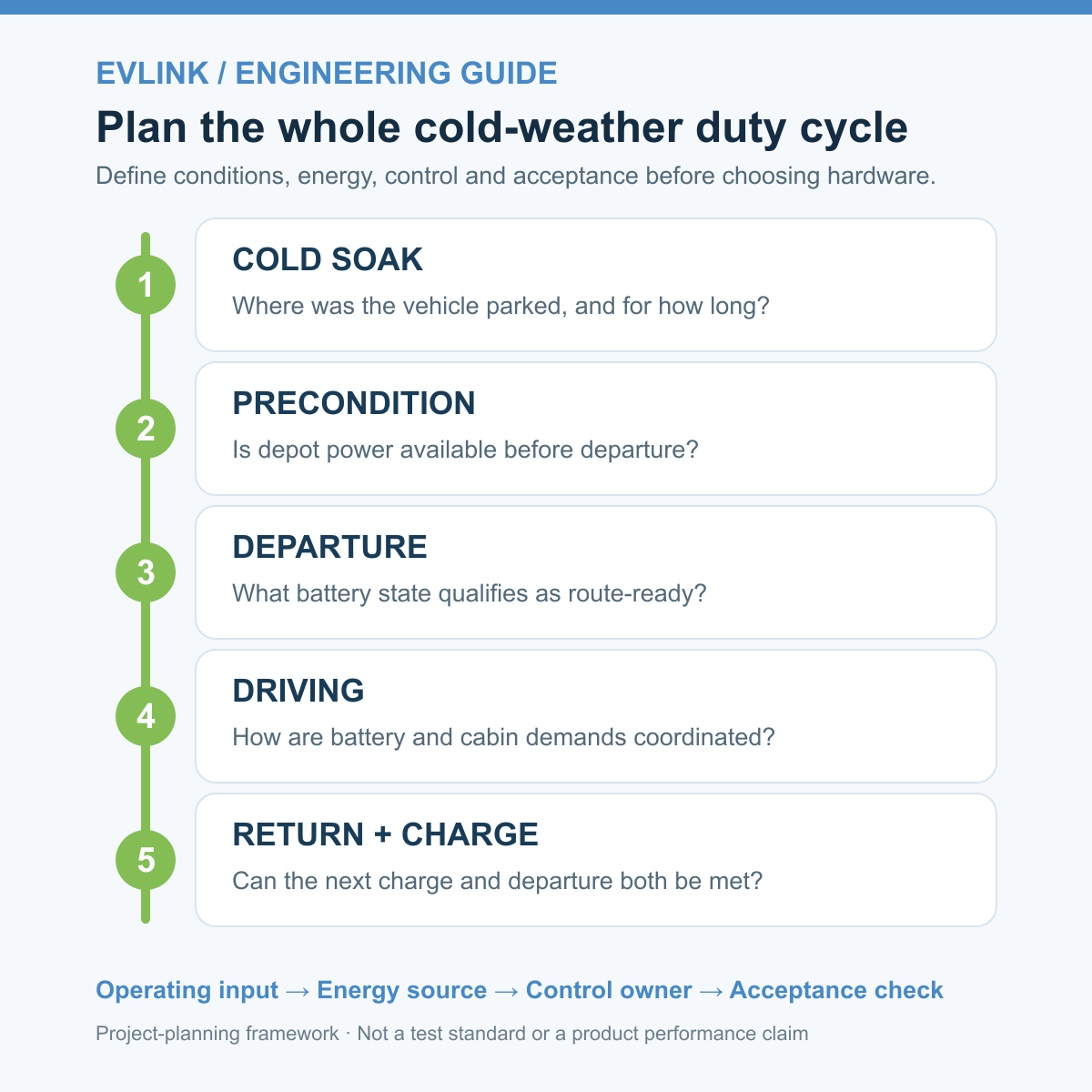
Map the duty cycle before specifying hardware
Use the following five-stage handoff as a project-planning tool, not as a test standard. It connects the fleet’s operating assumptions with the questions an OEM, battery team, and thermal-system supplier must resolve. Fill the cells with project data before requesting a system recommendation.
| Operating stage | Vehicle or fleet input | Available energy source | Who defines the control decision? | What should be observed? | Open question to resolve |
|---|---|---|---|---|---|
| Cold soak | Parking location, duration, starting battery condition | Record site power availability; do not assume preconditioning occurs | Fleet and OEM identify the condition; battery team defines limits | Battery temperature at defined sensor points, state of charge, ambient condition | What is the credible coldest starting condition for this duty cycle? |
| Plugged-in preconditioning | Charger connection window and departure time | External power if the vehicle and site permit it | OEM and battery team approve target; vehicle controls coordinate operation | Power drawn, temperature trend, elapsed time | Is enough power available while other charging or heating tasks run? |
| Departure | Required route or task and departure deadline | Onboard energy, subject to the vehicle design | BMS enforces battery limits; vehicle controls apply departure logic | Permitted power, temperatures, alarms, departure status | What measurable state qualifies as ready for this task? |
| Driving | Route, stops, payload, cabin demand | Onboard energy and any approved heat-recovery path | Vehicle controls set priorities within battery limits | Battery temperatures, energy use, derating events | How will competing cabin and battery demands be handled? |
| Return-to-depot charging | Arrival time, battery condition, next departure | Charger and vehicle systems, as available | Battery/BMS sets charging limits; vehicle/charger coordinate | Charge acceptance, temperature, faults, time to next readiness | Can the next charge and departure schedule both be met? |
This table is intended for qualitative analysis. It does not imply that all vehicles have the same powertrain, sensor configuration or preconditioning capabilities. If any item is missing from the table, you should consult the project team rather than making your own assumptions about the values.
Cold soak and available charging power
It is necessary to clarify the vehicle’s parking location, the duration of parking, whether it is connected to a charging device, and the likely state of the battery upon the next start-up. The description ‘parked outdoors overnight’ is incomplete: the initial state of the thermal management system also depends on the preceding driving conditions and the vehicle’s specific configuration.
Please consult the battery team to determine which measurement parameters reflect the critical state of the battery pack and which sensor locations are essential for setting operational limits.
If charging is available, it must be confirmed that the charging infrastructure and the vehicle can meet the power load required for the pre-conditioning process within the scheduled time window. The mere fact that ‘a charging device is connected’ does not directly prove that external energy is available for the thermal management system. Power allocation, charging scheduling and vehicle control strategies must be considered comprehensively.
Pre-conditioning and Departure Time Window
The start time, authorising party and termination conditions for pre-conditioning must be clearly defined. For a specific battery pack, the relevant limits and targets should be validated by the battery manufacturer.
Vehicle integrators should specify how these limits are translated into concrete instructions for the thermal management system and ensure that the driver or fleet operator is informed when the vehicle is ready for operation.
If the vehicle architecture supports preconditioning whilst connected to a charging device, the external power source can be utilised to reduce the need for the vehicle to consume its own stored battery energy to achieve a ‘ready’ state after the charging connector has been disconnected. This constitutes a conditional benefit rather than a fixed increase in range or energy savings.
Both the guidance on buses published by the ‘Joint Office’ and the US Department of Energy’s general guidelines on the winter use of electric vehicles discuss the value of preconditioning whilst the vehicle is connected to a power source. The latter is primarily aimed at consumer-grade electric vehicles; neither of these documents allows for the direct derivation of specific application outcomes for particular truck models or EVLINK products.
Driving, Return Journey and Next Charge
The vehicle’s departure does not mark the end of the thermal management task. During the journey, the battery’s operating limits may change, whilst the passenger compartment and other loads may also require heating. Integrators must clarify how the vehicle coordinates these demands; appropriate prioritisation depends on the vehicle’s actual architecture and safety constraints.
Upon the vehicle’s return, the battery’s state may determine when and how it is charged for the next operating cycle. This transition process should be incorporated into the same set of requirements as those for the morning departure.
If a system is capable of meeting pre-departure temperature targets but cannot support subsequent scheduled charging requirements, it does not fundamentally resolve the fleet’s overall operational challenges.
Clarifying battery boundaries and ownership of control
A distinction must be made between ‘battery requirements’ and ‘thermal management system capabilities’. The battery team is responsible for defining permissible operating conditions, whilst the vehicle team is responsible for determining how power is allocated and coordinating the various components. On this basis, the thermal management system supplier can then assess whether its equipment can meet the required operating conditions under the specified test conditions.
Confusion regarding these responsibilities often leads to requirements such as ‘rated heating power’ being specified without sufficient information from integrated evaluations.
Battery-Side Input Parameters to be Confirmed by the Original Equipment Manufacturer (OEM)
Operational limit parameters relevant to the anticipated operating conditions should be obtained from the battery manufacturer or the vehicle manufacturer, including: temperature measurement points, permissible charging and discharging conditions, State of Charge (SOC)-related limits, and constraints on temperature change rates or distributions.
The nature of each value must be clarified: which are control commands, which are safety limits, and which are merely monitoring reference values. Under no circumstances should a vague ‘ideal battery temperature’ be used as a substitute for these specific parameters.
The supplier requirements specification should also clearly define the cooling medium and the assumptions regarding the thermal circuit that affect performance, such as: inlet conditions, flow rate ranges, pressure limits, and the operating conditions corresponding to the performance metrics. If specific operating conditions are not defined and only a rated power value is provided, it will not be possible to demonstrate whether the system is capable of cold start-up.
Division of Responsibilities for Control Commands and Fault Responses
Clearly define the responsible party for each decision, including: start-up, shutdown, target value updates, status confirmation, alarm handling, and safety response mechanisms in the event of lost commands or sensor failure.
The control interface documentation should specify which team provides each signal and, in the event of conflicting constraints, clearly state which component holds the final decision-making authority. This forms part of the integration checklist and does not constitute a determination that a particular supplier supports all recommended control commands or communication protocols.
Comparison of ‘External Power Supply’ and ‘On-Board Power’ Approaches
Even if two vehicles are equipped with similar battery packs, the trade-offs in their pre-conditioning (preheating/pre-cooling) strategies may differ significantly. One vehicle may be connected to a reliable external power source before departure, whilst another may be parked in a location far from any power supply.
Even in a car park (fleet depot), the available electrical capacity may need to be allocated between ‘charging’ and ‘cabin pre-conditioning’. Before evaluating equipment solutions, the source of energy and the times when it is available must first be clarified.
For vehicles with an external power supply, it is necessary to confirm the amount of power that can be allocated to the battery, how this allocation affects the charging process, and whether the required pre-conditioning tasks can be completed within the scheduled departure time window.
For vehicles without an external power supply, it is necessary to clarify the proportion of on-board energy that can be utilised and to consider how the battery’s own operational limitations affect the pre-conditioning strategy.
For various types of buses or lorries, neither of these two approaches is inherently optimal. An effective comparative analysis should be based on identical initial conditions, the objectives set by the battery team, the time window, and the observed vehicle status.
Translating Operational Assumptions into a Supplier Requirements Specification
Based solely on ambient temperature and the heater’s rated power, suppliers cannot accurately answer the question: ‘Which battery thermal management system (BTMS) should be selected for winter use?’ Please provide a requirements specification that includes the following:
- The vehicle’s driving routes or operating cycles, including the most challenging cold start scenarios and the corresponding scenarios upon returning to the car park.
- The battery architecture, manufacturer-approved thermal and power limits, and the sensor locations used to monitor these limits.
- Parking and charging facilities, power supply, pre-conditioning (preheating/pre-cooling) time windows, and the load conditions of other electrical equipment.
- Coolant parameters, flow rate, pressure, inlet conditions, physical installation constraints and environmental conditions.
- Control responsibilities, interface requirements, fault response mechanisms, and the evidence required to validate the effectiveness of the proposed solution.
Suppliers are required to specify the operating conditions corresponding to each performance indicator and to indicate which aspects of the proposed configuration do not fully meet the requirements set out in the specification. This approach is more informative than selecting equipment based solely on rated parameters.
For a broader comparison of systems, please refer to our ‘BTMS Selection Guide’ and ‘BTMS Product Overview’ for electric lorries and coaches. These documents are for reference only and cannot be used directly as a basis for determining whether a specific model is suitable for cold weather conditions.
Establishing acceptance criteria for cold weather conditions prior to procurement
At least two observable stages should be clearly defined: whether the vehicle is ready to depart as scheduled after undergoing a specific ‘cold soak’ (low-temperature standstill); and whether the vehicle is ready for its next charging cycle upon returning to the depot.
For each stage, consensus should be reached on the initial conditions, energy sources, permitted preparation time, measurement points, data to be recorded, and the criteria for determining pass/fail. These standards should be jointly confirmed by the original equipment manufacturer (OEM) and the battery team, rather than being inferred solely from the supplier’s marketing materials.
For example, a cold start test plan may record battery sensor readings, ambient and coolant conditions, energy input, duration, alarm messages, and the permissible operating state of the vehicle at the time of departure. Tests upon return to the car park should record the vehicle’s condition on arrival, as well as the charging behaviour required for subsequent operations.
This is merely a suggested framework for a test plan and does not imply that a single set of values applies to all batteries. For a more comprehensive validation process, please refer to our separately provided ‘BTMS Validation Guide’.
Prepare a project brief for engineering assessment
Before seeking component recommendations, please compile the following information into a project brief: cold-soak conditions, vehicle departure and charging plans, permissible operating limits for the battery, available power, the condition of the cooling circuit, and the division of control responsibilities. Please ensure that any points that are not yet clear are explicitly noted.
This will provide a common basis for discussions between your team and the supplier, enabling you to determine which parameters can be set directly, which require further testing, and which aspects may necessitate adjustments to vehicle operations or depot strategies.
EVLINK provides application-specific information for electric buses and electric lorries in its Battery Thermal Management System (BTMS) overview. Whilst these materials will help you narrow down relevant product ranges, they are no substitute for a project-specific thermal management and control assessment.
Please inform EVLINK of your confirmed operating conditions and any outstanding issues. Initial discussions between both parties should focus on clarifying the scope of requirements rather than making specific commitments regarding winter performance.