Book Appointment Now


Liquid-Cooled Braking Resistors for Electric Commercial Vehicles
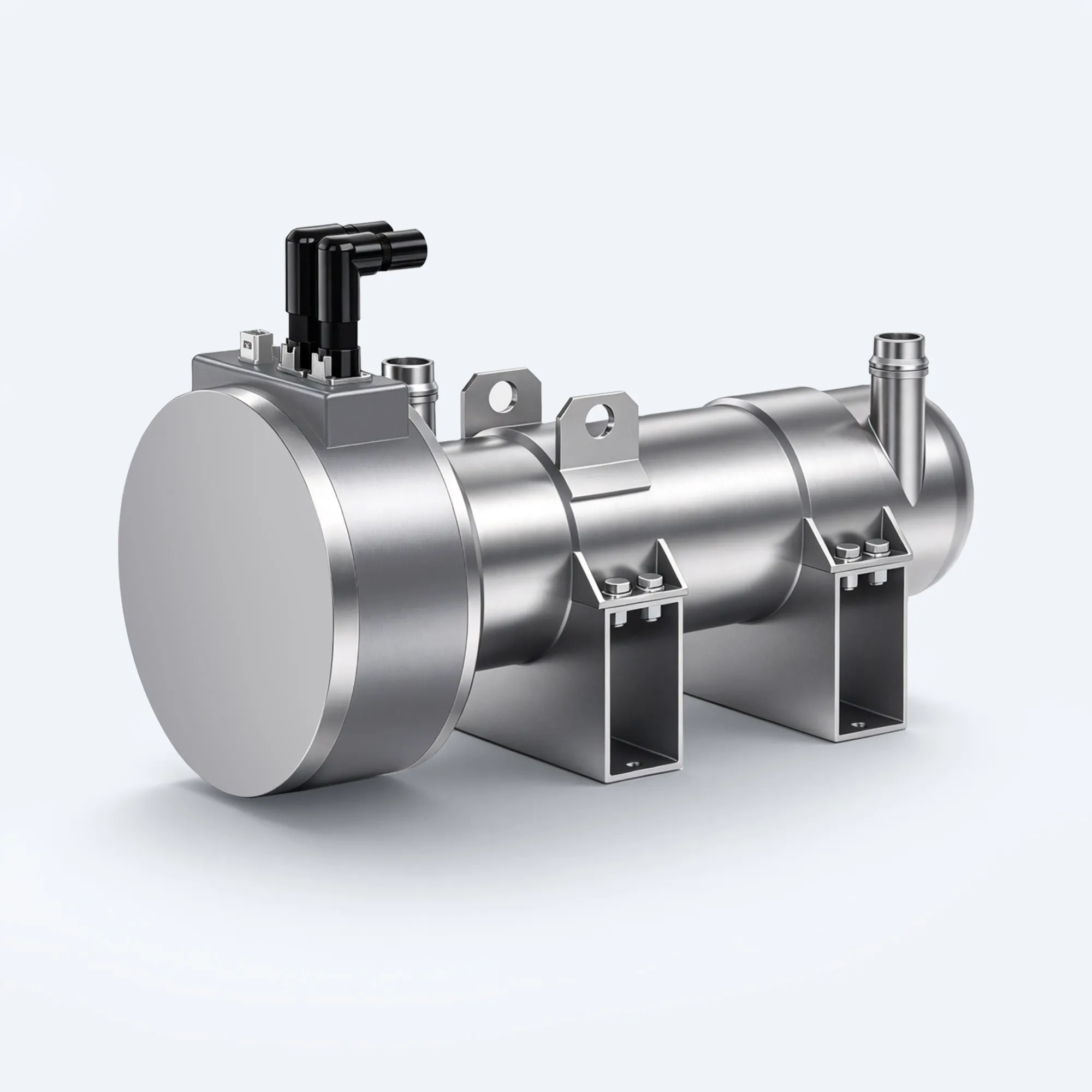
What it does
Every electric bus or truck eventually meets a hill its battery can't handle. Fully charged at the top of a long descent, there is nowhere for regenerative energy to go. The battery management system cuts regen to protect the pack, and the driver is left with friction brakes alone — on exactly the grade where they fade fastest.
A braking resistor is the pressure valve for that moment. It takes the energy the battery refuses and turns it into heat, holding continuous braking power while the friction brakes stay cool. On our HVH-R1402 series, that means 140 kW dissipated continuously for 20 minutes, straight into the vehicle's coolant loop.
Why liquid-cooled on EVs
Air-cooled braking resistors work. They are also big, loud, and hard to place on a vehicle that already fights for every cubic decimeter. At 140 kW continuous, an air-cooled unit needs serious airflow and a serious footprint.
Liquid cooling changes the math. The resistor dumps heat into the same water-glycol loop the rest of the thermal system already uses — no dedicated fans, no extra ducting, and the heat stays inside a circuit the vehicle already manages. The trade-off is real too: you need coolant ports (DN32 on ours), a pump that keeps up, and a control strategy that watches temperature. For a bus or heavy truck with a proper thermal loop, that trade is worth making. For a small vehicle without one, an air-cooled unit may still be the honest answer.
Specifications — HVH-R1402 series (140 kW model)
| Item | Value |
|---|---|
| Continuous power | 140 kW (20 min at max power) |
| Resistance | 2.24 Ω ±10% (cold, @25℃) |
| Bus voltage | 450–850 V DC (max 1000 V DC) |
| Rated current | 250 A |
| Protection | IP6K9K |
| Vibration | 6 g (ISO 16750-3) |
| Ambient temperature | -40℃ to +85℃ (operating to +110℃) |
| Dimensions | 659 × 232 × 253 mm |
| Weight | approx. 40 kg |
| Cooling | Liquid, 50% water + 50% glycol, DN32 ports |
| Temperature sensing | NTC 5K ±1% |
| Interlock | HVIL |
| Connectors | HV: TE 2-2399607-1; LV: TE 1-1703820-1 |
| Insulation | >100 MΩ @1000 V DC |
| Dielectric strength | 4000 V DC, 60 s |
| Materials | RoHS / ELV compliant |
| Mounting | Horizontal bracket or suspended |
| Validation | 25 production + type tests |
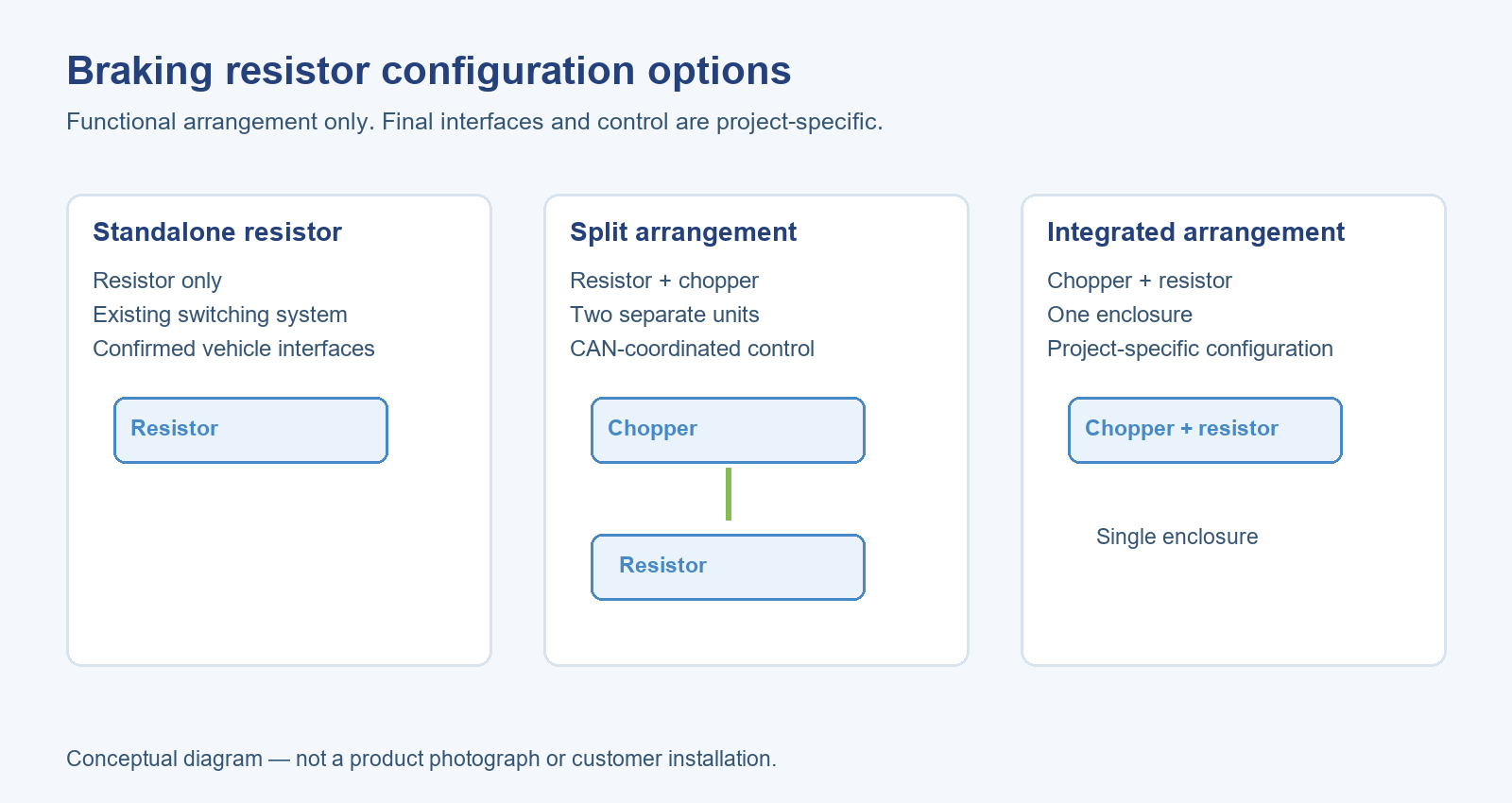
Three configurations
1. Standalone resistor unit. The HVH-R1402 itself, no chopper. For projects where the inverter or an existing chopper already handles the switching — the resistor just does what it does best.
2. Resistor + chopper, split. Our chopper controller paired with the resistor over CAN. As bus voltage rises, the chopper switches energy to the resistor by duty cycle. Two boxes, one control loop.
3. Integrated chopper-brake unit. Chopper and resistor in one enclosure, low-EMI design. For new platforms that want a single part number and a shorter harness.
Chopper controller parameters are confirmed per project — talk to us with your bus voltage and duty cycle.
Heat recovery: from burden to resource
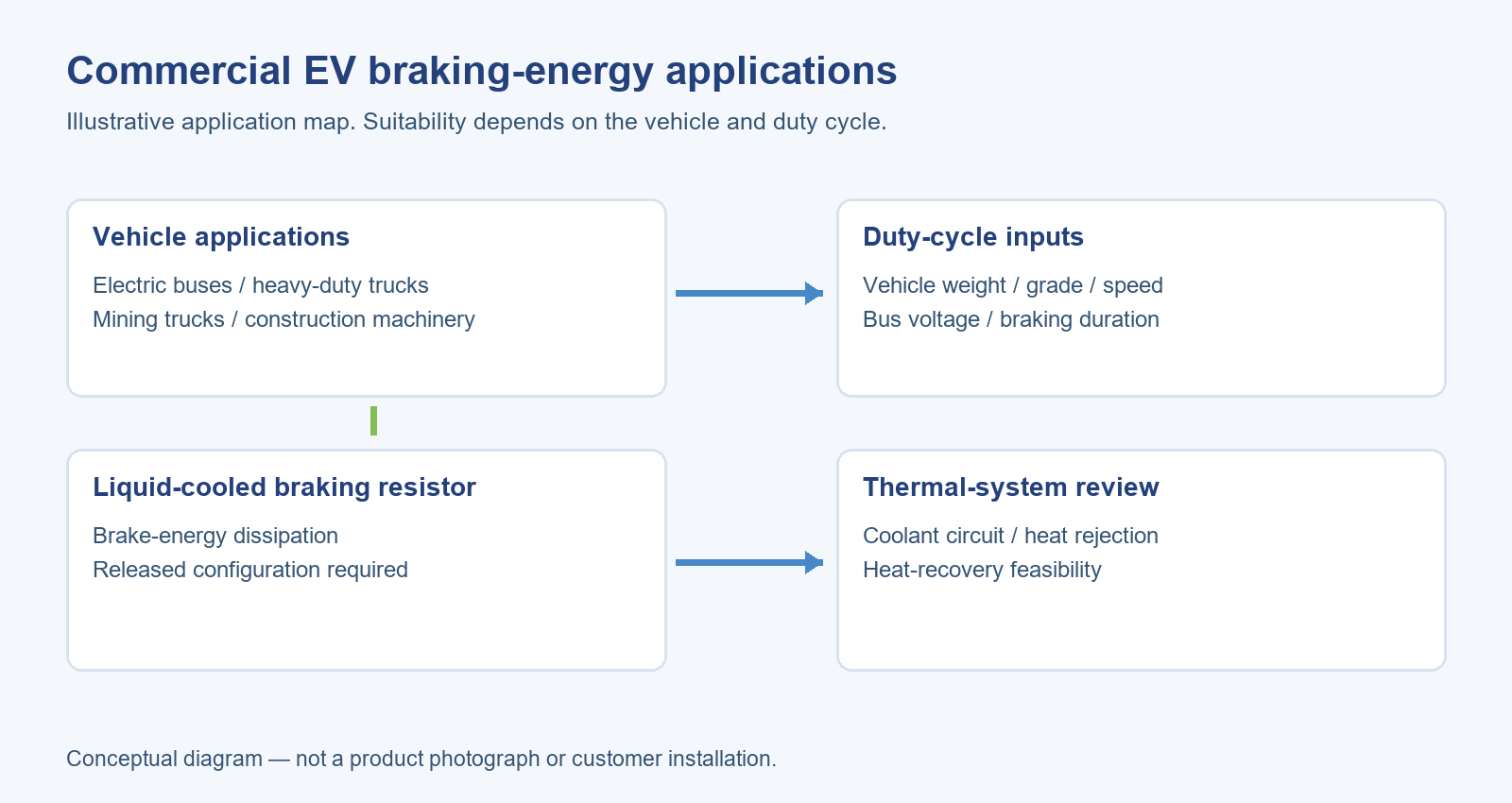
The heat doesn't have to be waste. On a bus in winter, 140 kW of braking heat is a meaningful number — routed through the coolant loop, it can preheat the cabin or take the edge off battery warm-up.
We build this resistor as part of a thermal system, not a standalone part. It sits on the same coolant architecture as our battery thermal management and high-voltage PTC heaters, and the same controller family as our three-in-one thermal management controller. One loop, one strategy.
Applications
- Electric buses
- Heavy-duty electric trucks
- Mining trucks
- Construction machinery
Typical duty: long downhill grades, heavy loads, frequent braking cycles.
Braking Resistor Manufacturer in China — OEM & Custom Supply
EVLINK designs and builds braking resistors in-house for electric commercial vehicles. Resistance is wound to order — tell us your bus voltage and duty cycle, and we match the winding to your platform instead of asking you to fit a catalog part. Every unit ships with temperature sensing and an interlock loop, because a resistor without them is a liability, not a product. Project-based supply, from prototype validation to volume.
Sizing it right
Three numbers size the resistor.
First, continuous braking power. Take vehicle weight, grade, and speed: a 20-tonne truck holding 30 km/h on a 7% grade needs roughly 100 kW — and the resistor must sustain it for the whole descent, not just the first minute.
Second, resistance. It has to match your DC bus. Ours is built around 2.24 Ω for 450–850 V systems, and we adjust the winding for other bus voltages without changing the platform.
Third, duty and cooling. How long the grade lasts, and what your coolant loop can carry away.
The mistakes we see most: sizing for peak power instead of continuous, forgetting how long the descent actually is, and leaving out temperature sensing and interlock. The design includes an NTC sensor and an HVIL loop. Check that whoever you buy from does the same.
FAQ
Start with continuous power (weight × grade × speed), match resistance to your bus voltage with U²/P, then check duty cycle and cooling. We walk through the full method in our sizing guide.
450–850 V DC continuous, up to 1000 V DC maximum.
Through the vehicle's coolant loop — 50% water + 50% glycol via DN32 ports.
Three options: resistor only, resistor plus a CAN-coordinated chopper controller, or a fully integrated chopper-brake unit.
IP6K9K sealing, 6 g vibration resistance, NTC temperature sensing, HVIL interlock, and 4000 V dielectric strength.
We don't claim product certifications we don't hold. The design is validated against 25 production and type tests referencing ISO 16750-3, ISO 20653, and ASTM B117, and materials comply with RoHS and ELV.
Yes. Resistance is wound to order for your bus voltage — the platform doesn't change.
Project-based. Send us your vehicle parameters and we'll come back with a configuration and schedule.
CTA
Send us your vehicle weight, typical grade and speed, and bus voltage. Our engineers will check the power and resistance match and come back with a configuration.