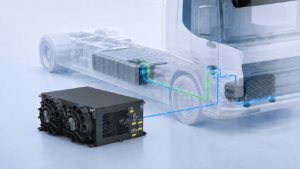
Estimate battery-loop coolant flow, then verify pump operating point, branch distribution and pack temperatures for an electric bus or truck.
A BTMS coolant-flow number is useful only when you know the heat duty, fluid and circuit behind it. A pump advertised at a certain L/min may deliver less once the cold plates, hoses, chiller and valves are installed. For an electric bus or truck, start with a thermal estimate, then check the full-loop pressure loss and the battery temperatures that the actual flow produces. This guide separates those three decisions so you can give suppliers a reviewable request.
Define where the heat and flow are measured
First, identify the coolant loop serving the battery. Does it pass only through the pack and chiller, or does it share branches with other vehicle loads? Mark the inlet and outlet where flow and temperature will be measured. A pump outlet reading is not necessarily the flow through every battery cold plate, especially when parallel branches or bypass valves are present.
Use the battery supplier’s approved heat-load data for the route, fast-charge event or other duty point. Record event duration, starting pack temperature, permitted cell-temperature range and coolant inlet condition. The battery heat-load worksheet addresses that upstream input. If you have only battery capacity in kWh, you do not yet have a cooling-duty number in kW.
Calculate a first-pass coolant-flow estimate
For a defined section of the loop at an approximately steady operating point, the sensible heat absorbed by the coolant follows:
Heat carried by coolant (W) = mass flow (kg/s) × coolant specific heat (J/kg·K) × coolant temperature rise (K).
Rearrange it to estimate mass flow, then divide by density to obtain volume flow. This is the standard energy balance described in the US Department of Energy heat-transfer handbook. Use the heat actually transferred at the chosen measurement boundary. During a transient, the battery and cold plate can store heat, so the pack’s instantaneous heat generation need not equal the coolant heat rate.
As arithmetic only, suppose 6 kW reaches a loop, the design allows a 5 K coolant rise, and an assumed fluid has a specific heat of 4.0 kJ/kg·K and density of 1.0 kg/L at that condition. The estimated mass flow is 6 ÷ (4.0 × 5) = 0.30 kg/s, or 18 L/min. This is not an EVLINK product rating or a recommended vehicle setpoint. Replace both assumed fluid properties with the approved mixture’s values at the relevant temperature. Recalculate for each duty point rather than copying 18 L/min into a specification.
The selected coolant temperature rise is itself a design choice. A larger allowable rise reduces the arithmetic flow requirement but may leave the downstream cells with warmer coolant. A smaller rise requires more flow and may raise circuit pressure loss. The battery supplier’s cell-temperature and uniformity limits decide whether either choice is acceptable.
Check the flow the installed loop can actually deliver
The thermal equation cannot select a pump. Obtain pressure-drop-versus-flow data for the cold plates, manifolds, chiller, hoses, fittings, filter and control valves at the intended coolant conditions. Add losses along the relevant flow path, then compare the system curve with the pump curve at its commanded speed and supply voltage. The operating point is where those curves meet—not the pump’s free-flow label.
Parallel battery branches need a distribution check. Total loop flow may look adequate while a high-resistance branch receives too little. Ask where branch flow or pressure can be measured and how bypass positions change the result. In published battery-cooling research, cold-plate geometry and flow are assessed alongside pressure drop and temperature uniformity, not as isolated numbers; see this SAE cooling-plate study.
If a supplier gives a single pump L/min value, ask for the pressure at that point and the test fluid and temperature. A useful quotation also identifies the pump’s control range, the loop configuration used for its flow prediction and which data still require a vehicle-level test.
Recheck the cold-start condition
For a vehicle parked in a cold climate, the fluid condition at startup can differ from a warm bench test. Request the approved coolant mixture and its temperature-dependent density, specific heat and viscosity. The mixture and temperature affect both the thermal calculation and hydraulic losses. Do not substitute pure-water properties for a glycol mixture or assume that warm-flow measurements prove cold-start circulation.
Define the startup sequence: when the pump runs, when valves open, how air is removed, and what the controller does if measured flow is below the battery supplier’s limit. The required limits and fault logic must be agreed for the actual pack and vehicle; this article does not set a universal minimum flow or protection threshold.
Give suppliers the same comparison package
Send one revision-controlled brief to every BTMS supplier. Mark each item as confirmed, estimated or open, so a preliminary quote is not mistaken for an approved design.
| Input or evidence |
What to specify or request |
| Thermal duty |
Heat-load curve or defined operating points, duration, pack starting condition and allowable cell temperatures |
| Coolant |
Approved fluid and concentration, property data versus temperature, fill and service constraints |
| Flow boundary |
Exact inlet/outlet measurement locations, branch layout, bypass and valve states |
| Hydraulics |
Cold-plate and component pressure-drop curves; proposed pump curve at relevant speed and voltage |
| Thermal response |
Predicted and measured coolant temperatures, maximum cell temperature and cell-to-cell spread at each duty point |
| Control and validation |
Flow sensing or inference, low-flow response, air-removal procedure, test conditions and acceptance records |
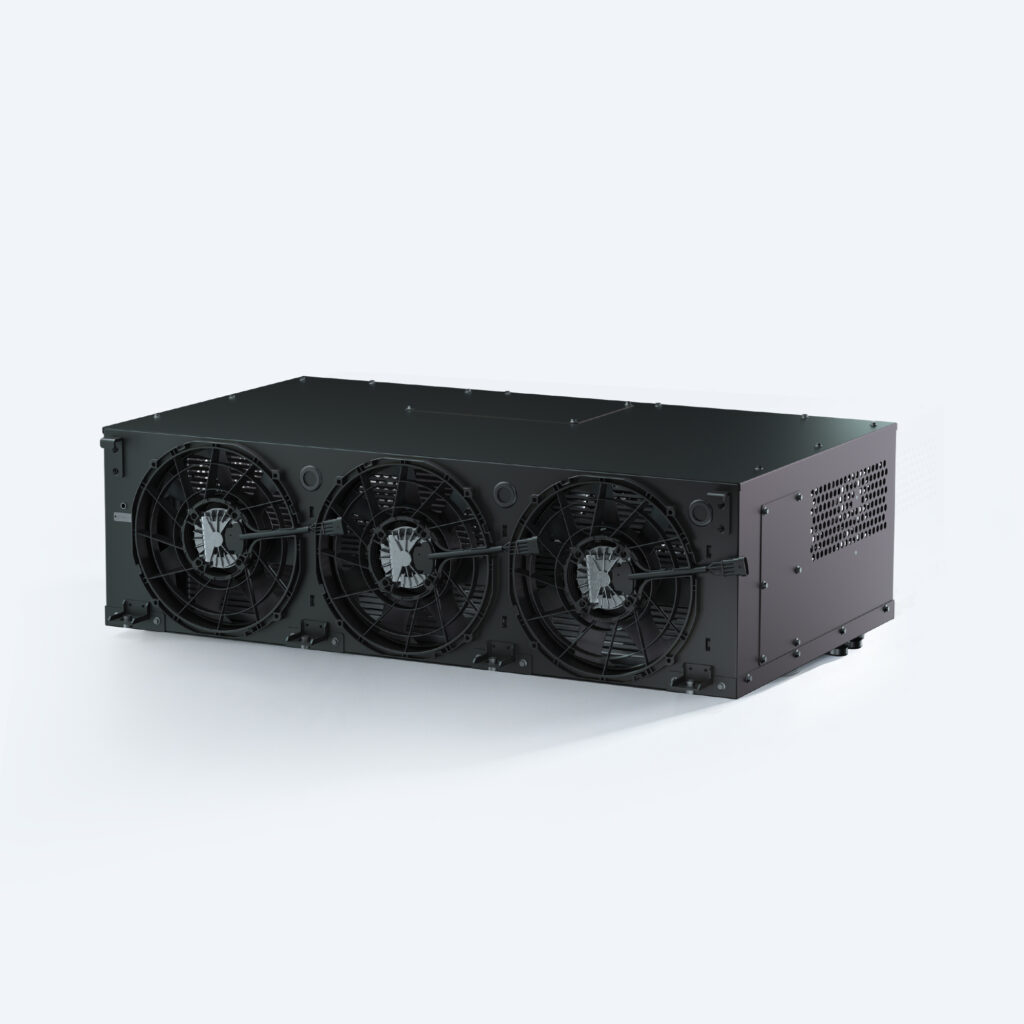
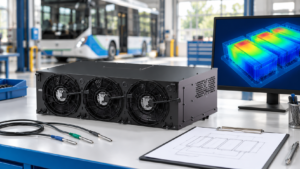
Ask suppliers to return their assumptions and deviations separately. The EVLINK BTMS range is a product starting point; a particular unit’s suitability must be checked against its configuration-specific performance and interfaces.
Validate with pack temperature, not flow alone
On a bench, record actual flow, pressure across the critical components, inlet/outlet coolant temperatures, pump electrical input, valve position and air-removal state. Repeat at relevant hot and cold fluid conditions. On the vehicle, record maximum and minimum cell or module temperatures during the defined route and charging events. A flow target passes only if the battery supplier’s temperature limits and the agreed system acceptance criteria also pass.
Modeling can help locate weak branches before hardware is built, but it does not replace measured behavior. A COMSOL battery-pack example couples channel velocity, pressure and battery temperature, illustrating why one L/min figure cannot describe the entire result. Use the separate BTMS validation guide to define the later acceptance plan.
Questions that often change the answer
Can I set flow from pack capacity in kWh?
No. Stored energy is not the heat-transfer rate. Use a pack-approved heat-load envelope for each driving or charging condition, then apply the chosen coolant temperature-rise constraint.
Is more coolant flow always better?
No. More flow can reduce coolant temperature rise, but it may increase pressure loss and pump energy without fixing poor branch distribution, high inlet temperature or limited chiller capacity. Judge the resulting cell temperatures and electrical cost together.
Does a warm-flow test cover winter operation?
Not by itself. Check the actual mixture properties and installed pump/loop operating point at the cold-start condition, then test the required startup and fault response.
Turn the calculation into an engineering review
If you are integrating a BTMS into an electric bus or truck, send EVLINK the approved heat-load cases, coolant mixture, loop schematic, cold-plate pressure-drop data, temperature limits and packaging constraints. Identify missing values explicitly. You can contact EVLINK with the current project brief to discuss which product family and hydraulic evidence should be evaluated next.