Book Appointment Now


A high-voltage coolant heater can meet its electrical power rating and still disappoint in a vehicle. The missing variable is often the coolant circuit: the actual flow through the heater at the coldest operating point, the pressure the pump can deliver, and the temperature the connected components allow. If you are specifying a heater for […]
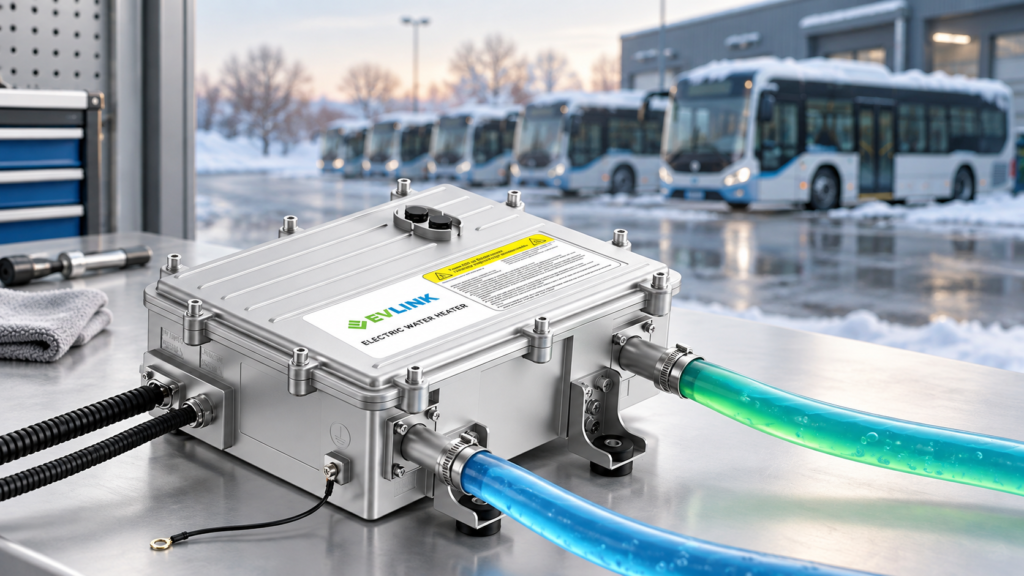
A high-voltage coolant heater can meet its electrical power rating and still disappoint in a vehicle. The missing variable is often the coolant circuit: the actual flow through the heater at the coldest operating point, the pressure the pump can deliver, and the temperature the connected components allow. If you are specifying a heater for an electric bus, truck, or off-highway machine, evaluate those conditions together. This guide gives your thermal and procurement teams a practical way to define the hydraulic requirements before requesting a heater quotation.
A kilowatt rating is meaningful only with its test conditions. Ask for the coolant inlet temperature, flow rate, coolant composition, and DC voltage used for the stated heat output. As a published example from another manufacturer, DBK reports different output at 45°C and 65°C inlet temperatures for the same 10 L/min flow condition. Those figures describe DBK’s model, not an EVLINK specification. They show why a bare “7 kW” comparison is incomplete. See the manufacturer’s stated test conditions.
At steady state, the heat transferred to coolant can be estimated as Q = ṁ × cp × ΔT, where ṁ is coolant mass flow, cp is the specific heat of the selected mixture, and ΔT is the temperature rise across the heater. This is a heat-balance calculation, not a substitute for a supplier performance curve or vehicle test. The mixture’s properties change with concentration and temperature; do not silently use water properties for a glycol circuit.
Flow that is too low can produce an excessive local or outlet temperature rise and trigger the heater’s control limits. Flow that is higher than necessary may reduce the inlet-to-outlet temperature rise without increasing the available electrical heating power. It also raises pump demand. The right target is therefore an operating range that meets the heat task while staying inside heater, pump, hose, and battery or cabin-loop limits.
The pump does not see the heater in isolation. It sees the pressure loss of every component in the open path: heater channels, hoses, bends, manifolds, valves, filters, heat exchangers, cold plates, and connectors. The pressure loss also changes with flow, coolant viscosity, temperature, and valve state. A catalog pump flow value measured at low resistance is not the flow the vehicle will necessarily achieve.
For each operating mode, draw the actual flow path and obtain a pressure-drop-versus-flow curve or measured points for its major components. Then compare the combined circuit curve with the pump curve at the available low-voltage supply and commanded speed. A technical review of liquid cooling notes that connector size and flow affect pressure loss across the system; a published high-voltage-heater study likewise treats outlet temperature and heater pressure drop as validation metrics. CPC liquid-cooling guide · SAE technical-paper abstract.
Cold start deserves its own check. The coolant mixture can be more viscous at low temperature, while a battery-preconditioning task often demands heat immediately. Model or measure the lowest expected coolant temperature and the approved mixture concentration. Do not reuse a warm-bench pressure-drop result as proof that the same flow will occur after an overnight cold soak.
| Input | What to provide | Why it matters |
|---|---|---|
| Heating duty | Heat required at each mode, target inlet/outlet temperatures, allowed warm-up time, and whether cabin and battery demands coincide | Separates the thermal requirement from a catalog peak rating |
| Coolant | Approved fluid, glycol type and concentration, fill quality, and lowest operating temperature | Determines fluid properties and material-compatibility review |
| Hydraulic path | Schematic, valve positions, branch splits, hose and port sizes, pump curve, and estimated pressure-loss curves | Shows the actual flow available at the heater, not just pump free-flow |
| Electrical and control interface | HV bus operating range, low-voltage supply, requested control protocol, enable/interlock logic, and power limits | Checks whether heat is available and controllable at the vehicle’s real conditions |
| Acceptance test | Required flow and heat output at defined inlet temperature, voltage, coolant mix, and ambient condition; limits on pressure loss and outlet temperature | Makes supplier comparisons and sign-off repeatable |
Ask the heater supplier to return a test-condition table, a pressure-drop-versus-flow curve, permitted flow range, outlet-temperature limits, and the applicable control/fault behavior for the specific model. If a value is unavailable, mark it “to be confirmed” instead of converting a competitor’s published number into an EVLINK claim. You can compare EVLINK’s publicly shown HVCH configuration families by interface, mounting and port layout before requesting model-specific hydraulic data.
A shared circuit can serve a battery loop, cabin heat exchanger, and other thermal loads. A total pump flow reading does not establish how much coolant passes through the heater when valves change position or a parallel branch opens. Identify the worst-case mode for the heater: it may not be the mode with the highest system flow.
For a bus that must leave a depot at a fixed time, specify the starting coolant and battery conditions, available charging or shore power, and the permitted preconditioning period. For a truck, add the first driving duty and next charging window. The controls team should define what happens when pump feedback is absent, flow is below its permitted range, an outlet-temperature limit is reached, or a valve reports an inconsistent state. Do not allow a simple heater-enable command to stand in for a coordinated pump-and-valve sequence.
If the battery and cabin loops have different temperature limits, define which device owns the target temperature and where it is measured. The heater outlet may be hotter than a downstream battery inlet after mixing; conversely, a sensor far downstream may hide a local heater limit. Use a sensor and valve plan that makes those conditions observable during commissioning.
These are proposed OEM acceptance steps, not a claim that a named EVLINK model has passed a particular certification or vehicle program. Agree the exact test limits and documents before the design is released.
Comparing only kilowatts: two heaters with the same headline rating may publish power at different voltage, inlet-temperature, and flow conditions. Require comparable points.
Using port diameter as a flow guarantee: port size helps define the hose interface, but it does not tell you the internal pressure loss or the installed flow.
Ignoring the coldest coolant condition: a warm test can miss the highest hydraulic resistance and the tightest preconditioning schedule.
Letting separate teams own separate limits: battery engineering, thermal engineering, controls, and purchasing should sign off on one operating envelope. Otherwise a heater may pass a component test yet fail the vehicle’s timing or temperature requirement.
No. More flow usually reduces temperature rise across the heater at a given heat output, but it also changes pump demand and branch distribution. Select a permitted operating range from the heat task, heater limits, and circuit curve.
No. The pump must overcome the pressure loss of the complete active circuit at the required flow, including cold-condition fluid properties and valve states. Compare the assembled-loop curve with the pump curve.
Request the heater’s pressure-drop-versus-flow data at stated coolant concentration and temperature. A single point may support an initial comparison but is insufficient to validate a variable-speed pump over multiple modes.
Yes if the loops have different temperature limits, schedules, or valve paths. State the simultaneous-demand case and who controls the temperature targets and power allocation.
No. Test conditions and designs are model-specific. Use third-party figures to frame RFQ questions, then obtain the selected EVLINK model’s approved data and validation report.
For a model-level review, send your intended vehicle application, HV bus range, requested heating duty, coolant specification, pump curve, flow and pressure-loss targets, port constraints, control interface, and cold-start acceptance condition. Use the EVLINK high-voltage coolant heater configuration guide to shortlist physical options, then contact EVLINK with the project brief. The engineering team can confirm which model data and verification documents are available for your configuration.

Sizing a braking resistor comes down to three numbers. Get them right and the resistor disappears into the vehicle, doing its job for years. Get
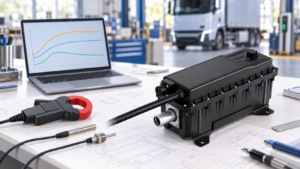
Verify HVCH power by separating requested output, electrical input and coolant-side heat transfer, with clear boundaries and project-specific acceptance criteria.
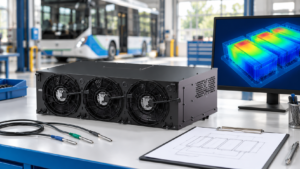
Separate measurement issues, coolant distribution and cooling capacity when investigating uneven battery temperatures in electric buses and trucks.
To make it easier for you to receive a quote, simply leave your information, and we will contact you as soon as possible.