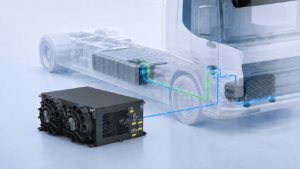
Define filling, circulation and acceptance evidence for liquid-cooled battery thermal management systems before thermal performance testing.
Before accepting a liquid-cooled battery thermal management system, confirm that coolant can reach the intended circuits in the operating modes you will use. A pump command, a full reservoir and a stable temperature at one sensor are useful observations. None is a complete commissioning record on its own.
This guide helps commercial electric-bus and truck teams define evidence for coolant-loop filling and air removal. It is an engineering review checklist, not a replacement for the vehicle, battery, pump or BTMS manufacturer’s approved procedure. High-voltage work and pressurized coolant handling belong to qualified personnel using the prescribed isolation and safety controls.
Define the circuit before defining the procedure
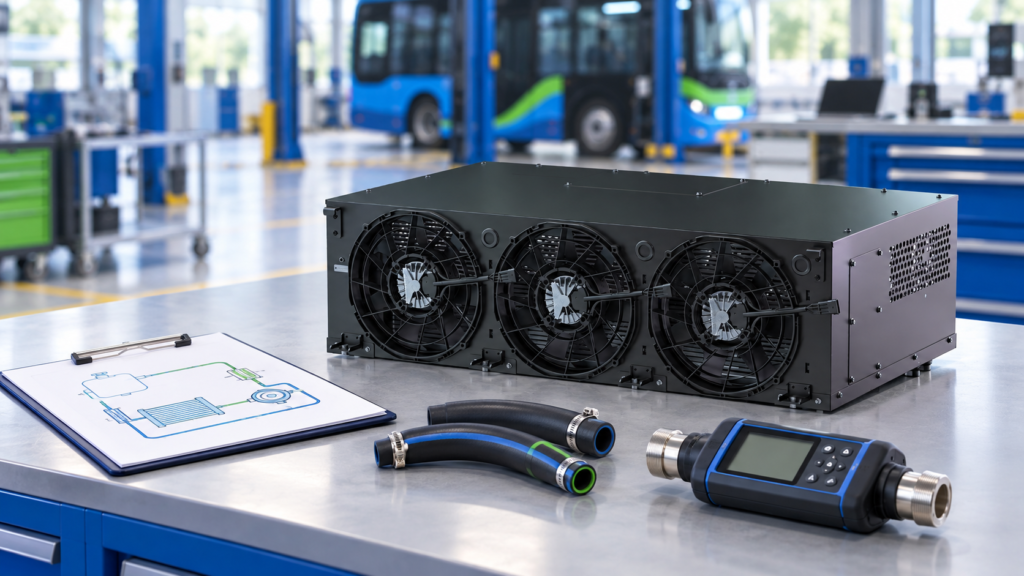
Start with the current coolant schematic and the physical installation. Identify the pump, battery branches, chiller or heater, reservoir, valves, fill connection and approved vent points. Mark component orientation and hose high points. A schematic that shows connectivity but not elevation may miss a practical filling question.
Then list the valve states that create different paths. If a branch is closed during filling, ask how the approved procedure fills and checks it. Do not assume that commissioning one path proves circulation through every operating mode. The purpose of this review is to expose missing instructions before running a thermal acceptance test.
Use the exact component documents. For example, Parker’s QDC006 manual requires pre-filling for its specified centrifugal pump and gives model-specific installation guidance for releasing air. Those instructions are not universal dimensions or mounting rules for an EVLINK unit. They illustrate why the installed pump’s own requirements must be checked.
Agree the filling method and the safety boundary
The vehicle program should approve the coolant specification, filling equipment, permissible pressure or vacuum, valve sequence and completion checks. There is no single bleed time, pump speed or coolant concentration that this article can prescribe for all commercial EVs.
Record which supplier owns each part of the procedure. The battery supplier may set fluid and pressure limits; the pump supplier defines priming and operating restrictions; the vehicle team defines access, isolation and valve commands. Resolve conflicting requirements before commissioning, rather than asking the technician to choose between them on the vehicle.
Do not run an unprimed pump or enable heating merely to see whether circulation appears. Do not bypass flow, temperature or electrical protection to finish a test. Any deviation from the approved sequence needs engineering authorization and a documented risk review.
Prove circulation instead of inferring it
A controller can report commanded speed while the hydraulic circuit still needs investigation. Agree how actual coolant flow will be measured, which branches need checks and where pressure and temperature will be recorded. Compare results with the project-specific requirements, not a generic value borrowed from another vehicle.
For a parallel battery layout, a total-flow measurement does not describe the distribution between branches. Review the measurement plan alongside the BTMS coolant-flow estimation and validation guide. The calculation establishes an input to selection; commissioning establishes what the installed circuit actually does.
If flow is unstable, noise changes or temperatures disagree, treat the observation as a reason to investigate. It is not proof that trapped air is the only cause. Valve state, restriction, pump inlet conditions, instrumentation and the approved fluid specification may also require review. Separate the symptom from the diagnosis in the test record.
Build a commissioning acceptance record
Use a short evidence pack that another engineer can repeat. Agree pass and stop criteria before testing; avoid deciding that a result is acceptable only after seeing it.
- Configuration: drawing revision, component identities, coolant specification, filling method and valve states checked.
- Initial conditions: ambient and coolant temperatures, reference fluid level, vehicle condition and approved isolation state.
- Measurements: actual flow at the agreed locations, relevant pressure readings, pump command and feedback, and time-aligned temperature data.
- Completion: the approved leak check, repeatability check and fluid-level review at the specified reference condition.
- Decision: requirements met, deviations, unresolved observations, responsible reviewer and permission to proceed to the next test.
Temperature data are easier to interpret when the measurement locations and timestamps are known. Use the BTMS temperature-sensor placement guide to review that part of the evidence. Do not use coolant outlet temperature as a substitute for the battery supplier’s required cell or module measurements.
Repeat relevant checks after service and cold starts
If the circuit has been opened, drained or reconfigured, define which commissioning checks must be repeated before returning it to operation. Keep the maintenance instruction consistent with the approved installation sequence, including branch and valve-mode coverage.
For a cold-climate program, record the fluid condition and repeat the agreed circulation check at the relevant starting condition. A warm workshop result should not automatically be accepted as evidence for an overnight cold soak. This is a request for project-specific validation, not a claim that every installation requires the same test temperature.
Review the cold-climate BTMS coolant-selection considerations with the fluid supplier’s data. Do not change the fluid mix simply to make a pump test easier. Recurring top-ups or changing flow should be investigated under the approved procedure rather than treated as normal completion of bleeding.
What to send for an engineering review
When discussing a battery thermal management system, send the coolant schematic, physical layout, pump information, battery-loop requirements, approved fluid specification and intended valve modes. Include the proposed fill and acceptance sequence, plus any measured observations from the installation.
Share your coolant-loop drawing and commissioning requirements with EVLINK. These inputs support a review of interfaces and unresolved integration questions. Final operating limits and acceptance criteria must remain consistent with the agreed vehicle and component documentation.
Technical reference: Parker QDC006 cooling-system manual. Its pump-specific instructions are cited as an example, not as EVLINK product instructions.