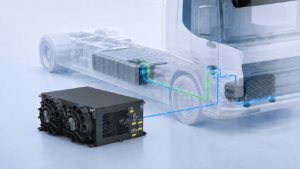
An OEM review checklist for battery-loop coolant specifications, component approval, cold-weather operation and commissioning evidence.
Choosing coolant for a battery thermal management system is not just a question of winter protection. Your fluid must suit the battery cooling plates, pump, heater, chiller, seals and service process as one circuit. Before you approve a coolant for an electric bus or truck, establish the exact specification and obtain component-level acceptance. This guide covers an indirect liquid-cooled battery loop; it is not a fluid recommendation for immersion cooling or a fuel-cell circuit.
Identify the circuit before choosing the fluid
Start with the thermal schematic. Mark which fluid passes through each component, where heat crosses a heat exchanger, and whether the battery cells contact the fluid. A liquid battery circuit and a refrigerant circuit are not interchangeable simply because both remove heat.
Valeo describes battery chillers as components connecting battery cooling with air conditioning. That distinction matters when preparing an RFQ: the battery-loop coolant specification belongs beside the hydraulic requirements, while refrigerant requirements belong to the refrigeration side.
If your project uses an indirect coolant loop, identify the actual wetted components. If it uses a different architecture, stop and request the applicable fluid specification. Do not transfer an indirect-loop approval to a direct-contact battery design.
Write an exact coolant specification, not a color
Record the supplier, product name, formulation revision, supplied concentration and dilution instructions. Include whether the fluid arrives ready to use or requires preparation. A purchasing description such as “green EV coolant” does not establish that a replacement has the same formulation or approval.
Request the current technical data sheet and safety data sheet. Separate the coolant supplier’s product claims from approval for your assembled circuit. The fact that a fluid is marketed for electric vehicles does not establish compatibility with every BTMS configuration.
BASF’s coolant portfolio distinguishes formulations for different electrified-vehicle applications. Use this as a reason to request the exact specification, not as permission to substitute one product for another.
Get agreement from every wetted-component supplier
Send the proposed fluid specification to the battery-pack, pump, heater and chiller suppliers. Include hoses, seals, fittings and any other wetted parts in the review. Ask each supplier to identify permitted fluids, concentration limits, operating conditions and restrictions. Keep their responses against the applicable part number and revision.
- Does approval cover the proposed concentration and preparation water?
- Does it cover the complete operating-temperature range?
- Are there restrictions on cleaning agents, additives or mixing?
- What evidence is required if the formulation or supplier changes?
Resolve conflicting requirements before ordering a thermal unit. A heater approval alone does not release the battery circuit, and a battery-pack approval does not establish the pump’s operating performance. Your project needs an agreed system specification.
Separate cold storage from cold operation
A winter parking requirement and a pump-start requirement answer different questions. Define the lowest storage condition, the condition when circulation must begin, and the temperature during heating, driving and charging. Record cold-soak duration and available preconditioning time rather than describing the project only as “for Europe.”
Ask suppliers to assess the proposed fluid at those operating points. Freeze protection is one input; it does not by itself establish acceptable circulation, heat transfer or component loading. Do not assume a room-temperature hydraulic review covers the first departure after an overnight cold soak.
Connect these requirements with your cold-weather preconditioning plan. The battery manufacturer still owns the battery’s approved operating limits. This article does not prescribe a universal departure temperature or glycol ratio.
Use properties for the approved mixture
Request density, specific heat and viscosity data across the relevant temperature range for the specified fluid and concentration. Identify the units and reference conditions. When a supplier provides a performance curve, check that its fluid and temperature assumptions match your project.
Review your battery-loop flow estimate and pump operating point using those inputs. A change in fluid or concentration deserves a documented review, not an assumption that the same pump setting produces the same result.
Keep the distinction between an estimate and acceptance evidence. Calculation helps establish a starting requirement. Measured circulation and battery temperatures under the agreed conditions establish whether the installed circuit meets that requirement.
Define cleanliness and electrical-property requirements
Ask the system owner whether electrical conductivity requires a specified limit, measurement method and service control. Do not invent a universal conductivity threshold or call a water-glycol coolant a dielectric fluid without the appropriate evidence.
DuPont discusses impurities in EV glycol-water circuits, including contamination arising over service life. For procurement, the practical question is what your approved circuit requires for fluid cleanliness and monitoring. A supplier’s purification product description is not proof that your project needs that product.
Include filling equipment, preparation water where applicable, cleaning residues and maintenance fluids in the review. Make the approved method available to whoever commissions or services the vehicle.
Agree the commissioning evidence before delivery
Prepare a release record linking the coolant specification, component revisions and filling procedure to the vehicle configuration. Identify the tests, instruments, acceptance criteria and responsible approver before the system arrives.
- Record the fluid product and batch information available from the supplier.
- Confirm preparation and filling against the approved procedure.
- Verify circulation and temperature measurements at agreed operating points.
- Document deviations and obtain approval before release.
- Retain the final configuration for later service and replacement reviews.
These are proposed review fields, not a claim that EVLINK has performed a particular customer test. Filling, leak checks and energized commissioning must follow the vehicle and component manufacturers’ instructions and be performed by appropriately qualified personnel.
Control service changes as part of the specification
Define what maintenance personnel may use for replacement and topping up. Set the inspection and replacement requirements from approved documents; do not apply a generic internet interval. Keep the fluid identity accessible alongside the vehicle’s service information.
If procurement proposes an alternative coolant, review compatibility and performance before use. Record who approved the substitution and whether any tests need repeating. A cheaper fluid is not a useful saving if its suitability remains unresolved.
Questions to resolve before a BTMS order
Is a common water-glycol ratio suitable for every BTMS?
No universal ratio is established here. Use the exact fluid and concentration accepted for your components and operating conditions. Another manufacturer’s product specification is not an EVLINK approval.
Can coolant choice wait until commissioning?
It should be defined early enough to inform compatibility and hydraulic reviews. Leaving it unresolved creates uncertainty in both component selection and acceptance testing.
Does an EV coolant label prove system compatibility?
No. Obtain configuration-specific acceptance and retain the supporting documents. Application descriptions help shortlist fluids; they do not replace system approval.
Prepare a coolant brief for your project
When reviewing an EVLINK battery thermal management system, provide your battery-loop schematic, proposed coolant specification, storage and operating conditions, hydraulic requirement and available component approvals. Highlight unresolved items rather than treating them as confirmed.
Send your BTMS project requirements to discuss the applicable product documentation and remaining inputs. A clear fluid brief helps your engineering and purchasing teams evaluate the same configuration.