Verify HVCH power by separating requested output, electrical input and coolant-side heat transfer, with clear boundaries and project-specific acceptance criteria.
A power request sent to a high-voltage coolant heater is not a measurement of heat delivered to the vehicle. If the reported output is lower than expected, first identify which quantity you are comparing: the requested power, electrical input, heat entering the coolant, or heat reaching the battery or cabin. This guide helps electric bus and truck OEM teams prepare a defensible HVCH power-verification test. It is not a live high-voltage troubleshooting procedure.
Define the power quantities before the test
The rated value belongs to the specified product configuration and operating conditions. The requested value is an instruction. Electrical input is measured at a defined supply boundary. Coolant-side heat transfer is evaluated across the heater’s fluid boundary. Heat delivered to a cabin or battery lies farther downstream and can be affected by the rest of the circuit.
Write the acceptance criterion around the quantity the supplier has agreed to provide. Record voltage, fluid conditions, flow, control mode and the measurement method. Do not compare a dashboard request directly with a coolant temperature reading and call the difference a power shortfall.
Do not assume every heater has the same power behavior
Heater technology and control architecture matter. For example, Webasto describes constant output for its HVH technology, while DBK publishes output ratings with stated inlet-temperature, flow and voltage conditions. Those statements apply to the manufacturers’ respective products. They are not EVLINK specifications or a universal characteristic of all coolant heaters.
For the selected EVLINK configuration, request the released operating envelope, power definition and control document. Whether a particular unit maintains, limits or adjusts output under your conditions must be established from those documents and the agreed test, not inferred from a generic PTC explanation.
Measure electrical input at an agreed boundary
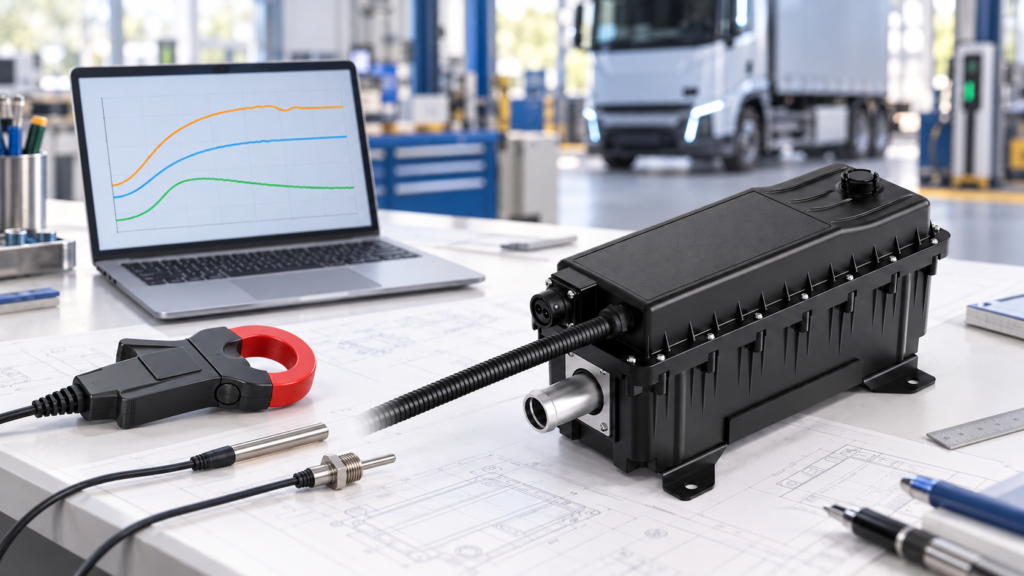
Qualified personnel should select appropriately rated, isolated instruments and follow the approved high-voltage test procedure. Define whether the measurement covers the heater’s high-voltage input only, its low-voltage electronics, or additional circuit equipment. A whole-vehicle battery reading is not automatically a heater input measurement.
For approximately steady DC conditions, input power can be estimated from measured voltage and current as P = V × I. If the signals vary significantly, use an appropriate power measurement or synchronized voltage-current acquisition. Multiplying separately averaged values can misrepresent time-varying input. Record the sampling method and instrument uncertainty.
Evaluate coolant-side heat under suitable conditions
For a defined flowing-fluid boundary under approximately steady conditions, the heat rate can be estimated as Qdot = mdot × cp × (Tout − Tin). Here mdot is mass flow, cp is the fluid’s specific heat capacity at the relevant composition and temperature, and the temperatures are measured across the heater. If you start from volume flow, account for fluid density and use consistent units.
Place the measurement points so they represent that boundary. An outlet sensor after another heat source or a long pipe does not isolate heater output. Use calibrated measurements and account for mixing, sensor response and flow uncertainty. A small temperature rise can make measurement error particularly important.
During warm-up, the housing, fluid and surrounding components can store energy. A transient difference between electrical input and the fluid estimate does not by itself establish poor efficiency. First distinguish stored energy, losses outside the chosen boundary and measurement uncertainty. Our HVCH warm-up response guide addresses the separate time-response task.
Read commands together with the operating state
Log the request, operating mode, relevant feedback and diagnostic state using the released communication definition. Confirm whether a field represents an allowed limit, a target, an estimate or a measured value. An acknowledged message alone does not prove that the requested heat was delivered.
Check the selected configuration’s enable conditions and protection responses. A temperature-control mode may not have the same purpose as a power-control mode. Do not clear faults repeatedly, bypass an interlock or defeat a protection function to force the requested output. Resolve the cause through the approved engineering procedure.
Use the mismatch to choose the next check
| Comparison |
Next evidence |
Avoid assuming |
| High request, low electrical input |
Control definition, enable state, supply conditions and diagnostics |
The heat exchanger is faulty |
| Electrical input is present, fluid estimate is lower during warm-up |
Time histories, stored-energy effects and measurement boundary |
The difference is entirely an efficiency loss |
| Heater-boundary output meets the agreed criterion, but the vehicle warms slowly |
Downstream routing, load and distribution evidence |
The heater rating must be wrong |
| Results vary between nominally identical runs |
Initial conditions, calibration, flow and configuration records |
A hardware change is already justified |
This matrix guides evidence collection; it does not establish a fault diagnosis. Keep unresolved explanations as hypotheses until the responsible engineers have reviewed the data.
Send a useful power-verification evidence pack
Include the exact configuration and document revision, agreed criterion, circuit drawing, measurement locations, instrument details, fluid composition, flow, initial conditions and synchronized logs. State which power quantity each trace represents. Record any protection events and changes between runs.
Use our HVCH flow and pressure-drop guide for the hydraulic input and RFQ checklist for supplier requirements. Review EVLINK high-voltage coolant heaters or share your verification brief with EVLINK. Model suitability and acceptance remain project-specific.