Book Appointment Now


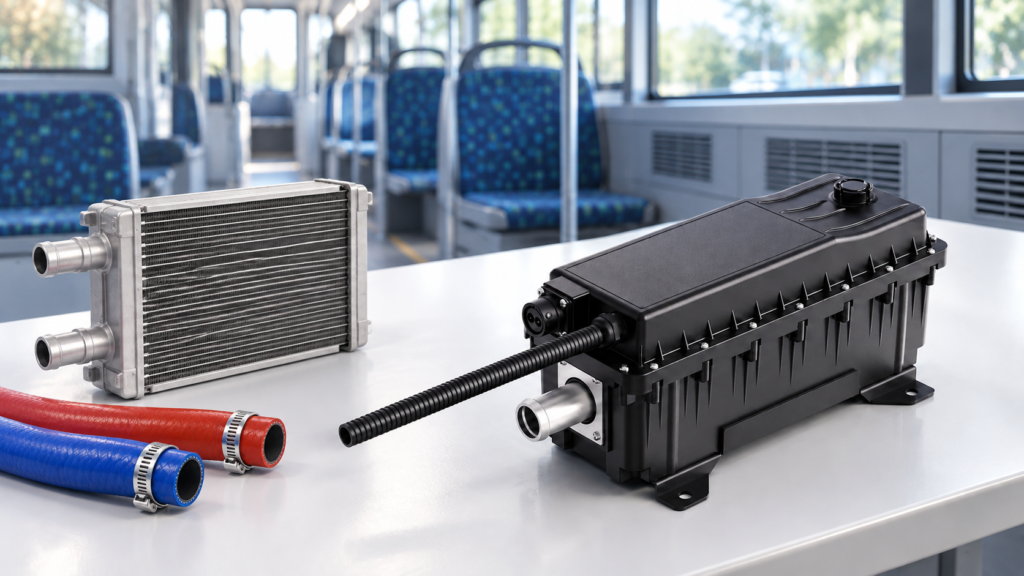
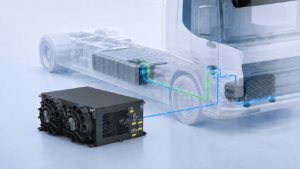
A PTC air heater transfers heat directly to cabin air. A PTC coolant heater transfers heat to a liquid circuit, which can deliver it to a cabin heat exchanger or an approved battery-heating path. For an electric bus or truck, choose between them by tracing where heat must go—not by assuming one heater type is always faster, cheaper or better for winter range.
If your requirement is cabin heating only, review the air-heating architecture. If the vehicle also needs liquid-based battery conditioning, review coolant heating and the valves, circulation and control needed to serve that duty. A combined system may be appropriate. Neither choice removes the need for vehicle-level sizing and protection.
PTC means positive temperature coefficient: the heating element’s resistance rises as its temperature increases. That characteristic is not a replacement for the complete heater’s controls, protections or installation requirements.
Webasto’s commercial-vehicle air-heater announcement provides a current example of PTC heating applied to vehicle interiors. Air heating is not restricted to passenger cars. However, the voltage and power of one manufacturer’s product should not be treated as specifications for every air heater.
With direct air heating, the system distributes warmed air through its approved cabin arrangement. With coolant heating, the liquid carries heat to another component. Eberspächer’s electrical-heater overview distinguishes air heating from coolant-circuit heating for interiors and battery conditioning.
| Decision | PTC air heating | PTC coolant heating |
|---|---|---|
| Heat delivery | Directly to the designed cabin airflow path | Through liquid to the connected heat exchanger or battery circuit |
| Battery duty | A cabin air heater does not itself heat a liquid-cooled battery circuit | Possible only with a suitable battery path and approved control |
| Integration review | Airflow, ducting, distribution, electrical supply and controls | Circulation, coolant compatibility, pressure drop, routing and controls |
| Performance comparison | Check delivered cabin heat under the actual duty | Check delivered heat to each required load under the actual duty |
The table describes architecture, not an EVLINK air-heater catalog or a universal cost ranking. This article’s EVLINK product path is the high-voltage coolant-heater range.
Write two requirements before selecting hardware. The cabin requirement should identify occupancy, ventilation, door-opening duty, defrost needs and the operating climate. The battery requirement should come from the battery supplier: starting condition, approved limits, preparation time and the relevant driving or charging duty.
A driver may feel warm while the battery still needs preparation. Conversely, an acceptable battery temperature does not establish that windscreen clearing or passenger comfort requirements are met. Treat these as separate acceptance tasks even when the heat source is shared.
Consider it when the required heat delivery is to cabin air and the proposed installation can provide suitable distribution. Review local comfort, airflow resistance, packaging and electrical power availability. If battery conditioning is handled by a separate system, show that boundary explicitly in the architecture.
Do not use vehicle size or an arbitrary outside-temperature threshold as the deciding rule. A small vehicle can still have demanding battery-conditioning requirements; a bus can use distributed air-heating components where the complete design supports them.
Consider it when heat needs to enter an existing or planned liquid circuit, including battery preparation or cabin heating through a liquid-to-air exchanger. The proposal must show how coolant reaches the intended load and how that load is isolated or controlled when its demand differs from another branch.
A coolant heater connected somewhere in the vehicle is not proof that the battery can receive the required heat. Check the hydraulic path, heat-exchanger arrangement and battery supplier’s coolant requirements. Use the project’s cold-weather preparation brief to define the actual starting condition and deadline.
A quote for an air heater and a quote for a coolant heater may exclude different equipment. List what is already present in the vehicle and what must be added. The useful comparison includes installation, controls, validation and service—not only the heater’s purchase price.
For air heating, identify the required blower or airflow source, air distribution, mounting clearances and electrical interface. For coolant heating, identify the pump, expansion and filling arrangement, hoses, valves, heat exchangers and any required sensors. Some of these may already belong to the vehicle; others may be additional scope.
Also compare the permitted service procedure. Air-heating access, coolant draining or bleeding, connector access and diagnostic support all influence maintenance. Obtain configuration-specific instructions rather than assuming one architecture is maintenance-free.
For a liquid system, review the HVCH installation checklist alongside the selected equipment drawings. Pump operation and heater enable must follow the approved control and protection requirements. PTC behavior does not justify dry operation or bypassing a flow-related interlock.
“Better winter range” is not a property established by the heater label alone. Define the useful heating task and compare the electrical energy required to complete it under the same starting condition, route or preparation window.
The first review should distinguish electrical input at the heater from useful heat delivered at the cabin or battery. Include the auxiliary equipment needed by each architecture and document whether the energy comes from the traction battery, an approved external source or another defined supply.
A coolant system may need to warm fluid and connected hardware before delivering the desired result. An air system’s useful response depends on its airflow and distribution. Neither observation supports a universal warm-up time. Measure the intended outcome in the installed vehicle.
If the vehicle has a heat pump, ask how it works with the proposed resistive heater. Obtain the available heating performance under the actual ambient and operating conditions, including any operating modes that affect usable output. The decision may be about supplementary heat rather than choosing only one technology.
Do not assume that every heat pump becomes unsuitable below one outside temperature or that every bus needs the same backup-heater size. Check the supplier’s performance data and the vehicle duty. State which component provides heat during startup, capacity limitation or an approved fallback condition.
Keep heater power sizing separate from architecture selection. The electric-bus coolant-heater sizing guide addresses duty and load inputs; a comparison article cannot replace that calculation with a universal kW recommendation.
Once the heat path is defined, match the proposed heater to the actual electrical supply. Nominal platform voltage is not the full operating range. Confirm allowable input, auxiliary supply, current demand, connectors and the conditions attached to the proposed output.
Both air and coolant heaters can be offered in different electrical configurations. “800V” does not tell you which thermal architecture is appropriate, and it does not establish compatibility with a particular vehicle. Use the 400V and 800V HVCH matching checklist for the liquid-heating proposal.
Identify the controller owning cabin demand, battery demand, available-power allocation and heater enable. Ask how rejected commands, missing inputs and shutdown are handled. A shared source should have an agreed priority policy rather than allowing different controllers to compete for the same output.
Provide a functional schematic and separate load requirements. Ask the supplier to identify the configuration, the included equipment and the documents supporting the proposed duty. Any claimed benefit should state the conditions under which it has been demonstrated.
For battery work, do not replace the battery supplier’s limits with a general temperature window found online. For cabin work, use the project’s comfort and visibility requirements. Approve the proposal against these requirements before comparing commercial terms.
No. That depends on connected heat exchangers, circuit routing, valves and approved control. The design must serve each load within its own limits. A shared heat source does not require every load to share the same coolant temperature.
No universal conclusion follows from the type alone. Compare the supplied scope, existing vehicle equipment, installation and delivered result under the same duty. Catalog power and a generic warm-up claim are not a vehicle acceptance test.
No. PTC describes the element’s electrical-temperature behavior. The assembly still needs approved controls, protection, supply and installation. Follow the selected product instructions and vehicle safety assessment.
If your review points to liquid heating, send EVLINK the supply range, separate cabin and battery heat requirements, circuit schematic and preparation duty. State which components already exist and which must be included in the proposed scope.
Request a high-voltage coolant-heater configuration review. Confirm the exact model, conditional performance and integration documents for your project rather than selecting only by a broad voltage or power label.

Sizing a braking resistor comes down to three numbers. Get them right and the resistor disappears into the vehicle, doing its job for years. Get
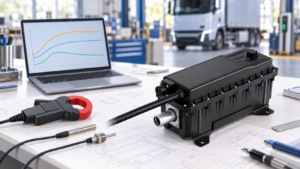
Verify HVCH power by separating requested output, electrical input and coolant-side heat transfer, with clear boundaries and project-specific acceptance criteria.
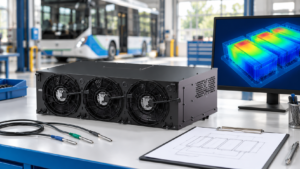
Separate measurement issues, coolant distribution and cooling capacity when investigating uneven battery temperatures in electric buses and trucks.
To make it easier for you to receive a quote, simply leave your information, and we will contact you as soon as possible.