Book Appointment Now


Battery Cooling System Quotations: What Is Actually Included?
Compare battery cooling system quotations for electric buses and trucks. Check included hardware, coolant interfaces and control responsibilities before approval.
When it comes to battery cooling systems, two quotes may list the same nominal capacity, but the scope of supply they cover can vary significantly. One quote may include a circulation pump and an expansion tank, while the other may rely on the vehicle’s built-in equipment. Neither approach is inherently right or wrong, but a fair price comparison cannot be made until the scope of supply for each is clearly defined.
For electric bus or truck projects, ask suppliers to reference the circuit diagrams to clearly specify the included hardware, external integration requirements, and control responsibilities. Be sure to finalize this list during the sample approval phase to avoid discovering missing components during installation.
Start with the Selected Configuration
Product series descriptions are not the same as a Bill of Materials (BOM) for a specific order. Document the proposed model, hardware version, and mutually agreed-upon options. At the same time, confirm whether each item is to be provided by the supplier, procured by the customer, or remains to be determined.
The EVLINK BTMS (Battery Thermal Management System) product series can serve as a starting point for selection. The final configuration and interfaces must be verified based on the selected solution; never assume that products with different capacity specifications use the same liquid reservoir, water pump, or heating configuration.
| Boundary | Questions to settle |
| Coolant circulation | Which pump is included, which circuit does it serve, and who confirms the installed operating point? |
| Expansion and filling | Is the tank internal or external, and who supplies level sensing and the approved filling procedure? |
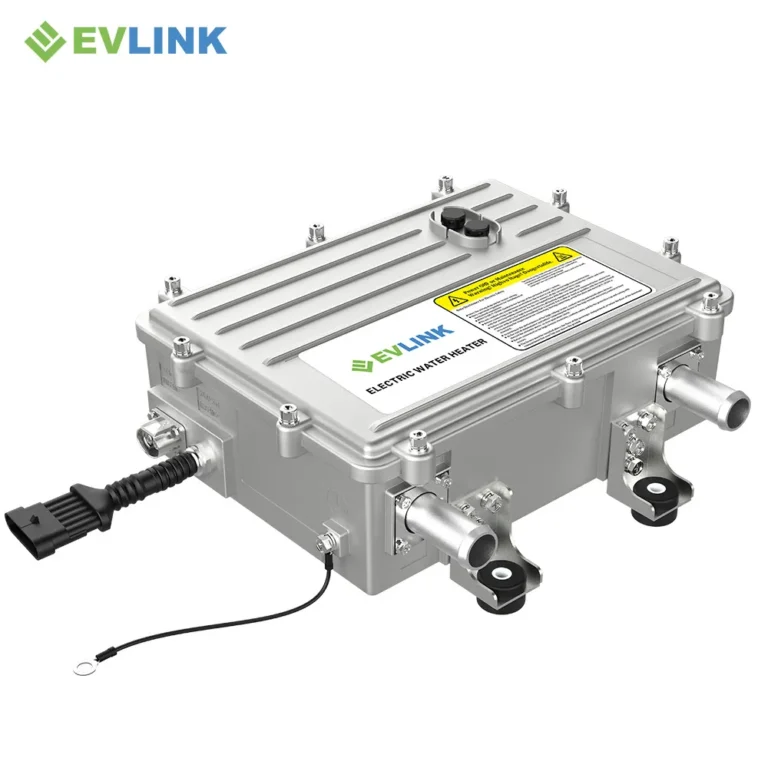
| Heating | Is heating included, and which electrical and control interfaces does it require? |
| Refrigeration | Is the refrigerant circuit supplied complete, and which connections or commissioning tasks remain external? |
| Sensors and valves | Which devices are supplied, where are they installed, and which controller uses their signals? |
| Harnesses and connectors | Are mating connectors, cables and vehicle harness sections included or separately specified? |
Simply providing a pump does not mean the hydraulic system design is complete.
Battery cold plates, hoses, valves, and fittings are all part of the installed circuit. Be sure to verify that the selected pump can meet the flow rate required by the circuit under the specified coolant operating conditions. The pump’s rated flow rate does not guarantee that each battery branch will receive the corresponding flow rate.
For multi-battery pack systems, it is essential to distinguish between the total circulation flow rate of the entire system and the distribution flow rates required by each battery pack. Coolant flow rate evaluation guidelines can help streamline the assessment process, but the final acceptance criteria should still be based on the limits set by the battery supplier and the technical specifications of the selected components.
Before connecting the controller, the assignment of control authority must be clearly defined.
“Support for CAN communication” does not equate to having a complete vehicle-level control strategy. It must be clearly defined: who initiates cooling or heating requests, who issues commands to the water pump and valves, who provides feedback on operating limits, and which controller is responsible for authorizing the vehicle’s response actions.
For each external component, document its power source, control signals, feedback mechanisms, and response logic in the event of a communication interruption. Never assume that a component has some sort of “fail-safe” (fallback) mechanism simply because it supports CAN communication; be sure to verify the selected software version and project interface specifications.
Refer to the BTMS (Battery Thermal Management System) CAN Integration Guide to clarify signal definitions. In vehicle test records, strictly distinguish between “request status” and “confirmed actual operating status.”
When comparing quotes, ensure that evaluations are based on the same “Scope of Work.”
Compare each supplier’s quote against the same version of the drawings and requirements documents. Clearly indicate which hardware, engineering work, debugging tasks, documentation preparation, and validation responsibilities are not included in the supplier’s scope of supply or services. If an item is labeled only as “customer preparation,” be sure to verify its specific meaning.
This approach also helps the procurement department assess the impact of changes. A lower equipment quote may indicate a narrower scope of supply, while a more highly integrated assembly may still require coordination with the vehicle manufacturer for subsequent development or installation work. Comparisons should be based on the mutually agreed-upon scope of supply, rather than simply assuming that one solution will result in a lower total installation cost.
Ensure Traceability for the Initial Integration Review
Prior to installation, verify that the delivered components conform to the approved configuration. Check connector versions, fluid interfaces, installation information, and applicable software identifiers. Clarify which party is responsible for documenting deviations and approving alternatives.
Prototype acceptance should focus on verifying established interfaces and operating modes, rather than merely confirming that the equipment is functional. Follow approved electrical and fluid handling operating procedures. Under no circumstances should the equipment be powered on while interface issues remain unresolved, nor should it be forced to operate by bypassing protective measures.
When conducting an EVLINK review, provide details on battery requirements, thermal loads, cooling circuits, available power, controller architecture, and proposed supply boundaries. When sending project information, clearly list what you expect the supplier to include. Require the supplier to submit a mutually confirmed configuration list and division of responsibilities along with their quote to ensure that both teams are basing their cost estimates and verification on the same system.