Define heat pump and HVCH duties for electric buses and trucks. Review supplemental heat, shared-loop priorities, power limits and mode-transition evidence.
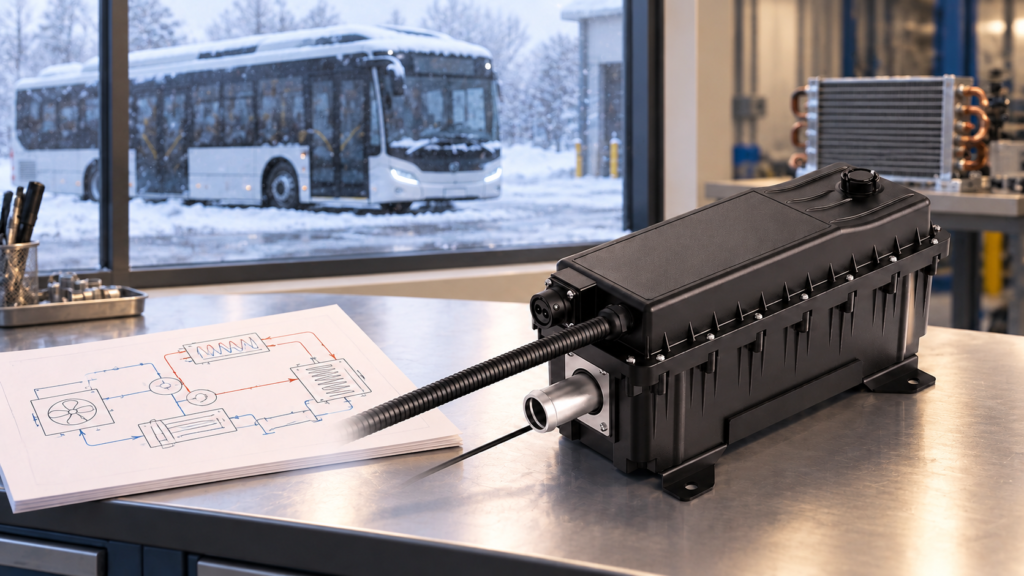
A heat pump and an HVCH do not have to perform the same job. In an electric-bus or truck heating concept, a high-voltage coolant heater may be assigned to warm-up assistance, supplementary heat or a defined fallback mode. Decide which duties it must cover before choosing a heater rating—or deciding that no separate coolant heater is needed.
There is no universal outdoor temperature at which every vehicle must switch from its heat pump to an HVCH. The decision depends on the actual architecture, available heat, required delivery temperature, vehicle power budget and accepted operating modes. This guide helps you prepare that system-level brief; it is not a controller calibration or a claim that every heat pump needs a backup heater.
Define the heater’s role in each vehicle mode
Start with the vehicle tasks rather than a comparison of component brochures. Record which heat consumers must be served, their priorities and the allowed response time. Battery preparation, cabin comfort and windscreen clearing may have different requirements; the OEM must define the applicable limits and safety obligations.
- Normal heating: what should the heat pump supply, and when is supplementary heating permitted?
- Cold start or departure preparation: what heat is needed before the system reaches its normal state?
- Temporary limited output: what, if anything, must the heater cover during an agreed transition or de-icing event?
- Defined degraded mode: which functions must remain available, for how long and under which restrictions?
These are questions for a project mode matrix, not a universal requirement to support every mode. Calling a heater “backup” does not establish that the complete system is fault-tolerant: shared power, pumps, valves or controls may still limit what it can deliver.
Use confirmed heat-pump output at the required condition
MAHLE describes a combined electric-heater and heat-pump concept in which the heater covers critical heat-pump operating conditions. Its passenger-car example does not define the heater duty for your bus or truck, and its range figures should not be reused as an EVLINK benefit.
Request the heat-pump supplier’s output at the relevant source conditions, delivery temperature and operating mode. Identify any time limits, transitions and constraints in that evidence. Do not subtract an “up to” brochure output from a design heat load and treat the remainder as a validated HVCH size.
If a supplementary duty is estimated as required heat minus confirmed heat-pump contribution, keep both quantities on the same thermal boundary and time basis. That estimate is only a starting point. Validate heat distribution, warm-up response and electrical constraints before release; a nominal arithmetic balance does not demonstrate installed performance.
Check what de-icing means for the selected system
Valeo’s electric-bus heat-pump announcement describes an automatic de-icing mode for its named system. It demonstrates that this behavior is part of the architecture to review, not that another heat pump has the same performance or needs the same auxiliary heater.
Ask how the proposed system maintains or temporarily changes heat delivery during its actual de-icing sequence. Agree what the vehicle permits in that interval and what evidence is required. Avoid assuming either uninterrupted heating or a complete loss of heating without the supplier’s mode description.
Resolve shared-loop and power priorities
If the cabin and battery share a heat source or coolant path, show the valves, pumps, consumer requirements and temperature boundaries in the review. A coolant heater cannot satisfy two incompatible temperature requirements merely because their requested powers add up to less than its rating. The thermal-system owner must confirm routing and control responsibilities.
Also check the vehicle’s available electrical power in each mode, including relevant auxiliary loads. A commanded heater output is not proof that the vehicle can sustain the necessary input during driving or charging. Record which controller authorizes heat, which controller enforces power limits and what happens if communication or a required enabling condition is unavailable. Final behavior must follow the project’s released safety and control documentation.
Validate the transitions, not only the steady state
Build the test plan around the agreed mode matrix. Record initial temperatures, heat demand, heat-pump state, HVCH request and feedback, relevant coolant temperatures and flow, and the vehicle’s electrical limits on a synchronized time base. Include entry and exit from supplementary operation rather than checking only a settled warm condition.
Use the existing HVCH duty-cycle sizing guide for the heating demand and the heater RFQ checklist for supplier inputs. Keep acceptance criteria project-specific. Do not intentionally disable protections or introduce high-voltage faults outside an authorized validation procedure.
Prepare a combined heating brief for EVLINK
When considering the EVLINK coolant-heater range, provide the mode matrix, confirmed heat-pump contribution, consumer temperature requirements, coolant circuit and available electrical supply. Identify whether the requested heater duty is assistance, supplementary heating or a specifically defined fallback function.
Discuss your heat-pump and HVCH duty allocation with EVLINK. Request confirmation for the selected heater configuration and its conditions; this general planning guide does not establish a heater’s safety role, output or compatibility with a particular heat-pump system.