Book Appointment Now


An electric bus may have a fixed first departure. An electric truck may have a long drive, an early loading window, or limited time at the depot. In both cases, a battery that has sat in the cold raises a practical question: will the vehicle be ready to leave and accept its next charge under the battery manufacturer's limits? The answer depends on the vehicle, battery, available power, control strategy, and operating schedule. Before choosing thermal hardware, define those conditions as a project requirement. This guide shows what to ask, who should answer, and how to judge readiness without assuming that one target temperature or heater rating fits every fleet.
Why cold-soaked batteries complicate departure planning
Cold-weather planning is a scheduling problem as much as a thermal one. The pack starts at a condition set by its parking environment and previous duty cycle. The project then has a finite window to prepare it for departure. Whether the battery can deliver the required power or accept charging at that point must be assessed against limits approved by the battery or vehicle manufacturer, not a generic target copied from another project.
For battery-electric transit buses, the U.S. Joint Office recommends planning for demanding cold-weather operating days and discussing battery preconditioning with the manufacturer. Its cold-weather transit-bus guidance also notes that the appropriate target and control interface depend on the vehicle and battery supplier. Those bus recommendations are a useful prompt for truck projects, but they do not establish a universal truck requirement.
Start with the actual operating pattern. A bus may need to make a scheduled departure after an overnight cold soak. A truck may need to reach a loading point, meet a delivery time, or recharge after a different route. In each case, record the starting condition, the allowed preparation window, and the task the battery must support. These three inputs define the problem more clearly than an ambient-temperature label such as “winter operation.”
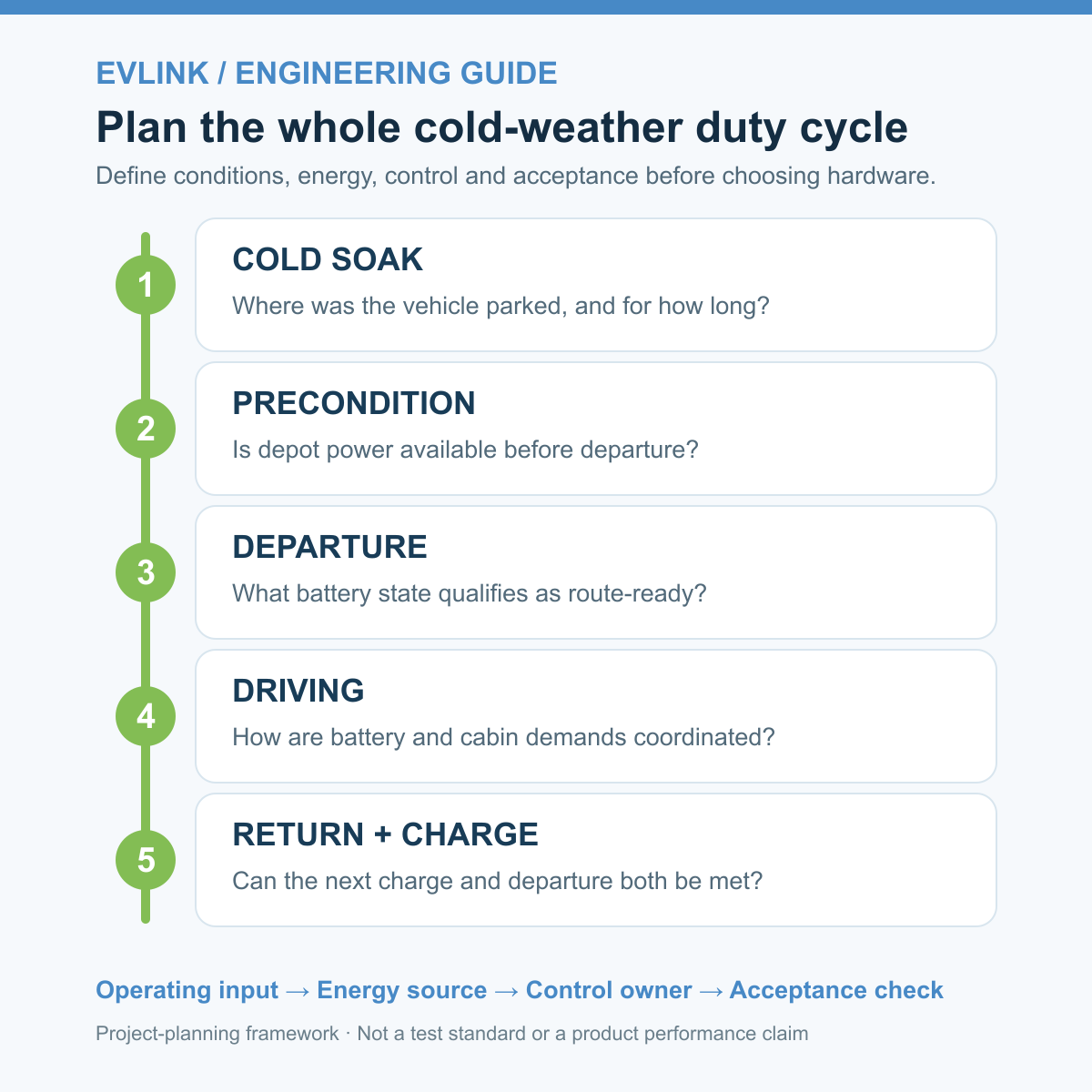
Map the duty cycle before specifying hardware
Use the following five-stage handoff as a project-planning tool, not as a test standard. It connects the fleet's operating assumptions with the questions an OEM, battery team, and thermal-system supplier must resolve. Fill the cells with project data before requesting a system recommendation.
| Operating stage | Vehicle or fleet input | Available energy source | Who defines the control decision? | What should be observed? | Open question to resolve |
|---|---|---|---|---|---|
| Cold soak | Parking location, duration, starting battery condition | Record site power availability; do not assume preconditioning occurs | Fleet and OEM identify the condition; battery team defines limits | Battery temperature at defined sensor points, state of charge, ambient condition | What is the credible coldest starting condition for this duty cycle? |
| Plugged-in preconditioning | Charger connection window and departure time | External power if the vehicle and site permit it | OEM and battery team approve target; vehicle controls coordinate operation | Power drawn, temperature trend, elapsed time | Is enough power available while other charging or heating tasks run? |
| Departure | Required route or task and departure deadline | Onboard energy, subject to the vehicle design | BMS enforces battery limits; vehicle controls apply departure logic | Permitted power, temperatures, alarms, departure status | What measurable state qualifies as ready for this task? |
| Driving | Route, stops, payload, cabin demand | Onboard energy and any approved heat-recovery path | Vehicle controls set priorities within battery limits | Battery temperatures, energy use, derating events | How will competing cabin and battery demands be handled? |
| Return-to-depot charging | Arrival time, battery condition, next departure | Charger and vehicle systems, as available | Battery/BMS sets charging limits; vehicle/charger coordinate | Charge acceptance, temperature, faults, time to next readiness | Can the next charge and departure schedule both be met? |
The table is deliberately qualitative. It does not imply that every vehicle has the same power path, sensors, or preconditioning function. Any missing item is a question for the project team, not a value to guess.
Cold soak and available depot power
Specify where the vehicle parks, how long it sits, whether it is connected to a charger, and what the battery condition may be at the next start. “Outdoor overnight parking” alone is incomplete: the thermal starting point also depends on the preceding trip and the vehicle's configuration. Ask the battery team which measurements represent the pack's relevant condition and which sensor locations matter for its limits.
If a charger is available, confirm that the site and vehicle can actually supply the proposed preconditioning load during the intended time window. A charger connection does not by itself prove that external energy is available to the thermal system. Power allocation, charger scheduling, and vehicle controls must be checked together.
Preconditioning and the departure window
Define when preconditioning may begin, who authorizes it, and what ends it. The battery manufacturer should approve the relevant limits and targets for the particular pack. The vehicle integrator should specify how those limits are translated into a request to the thermal system, and how the driver or fleet operator will know whether the vehicle is ready.
Where the architecture permits preconditioning while plugged in, external power can reduce the need to use stored battery energy for preparation after unplugging. This is a conditional benefit, not a fixed range or energy saving. Both the Joint Office bus guidance and the U.S. Department of Energy's general EV winter guidance discuss the value of preparing a vehicle while it is connected to power. The latter is consumer-EV guidance; neither source proves a particular result for a truck model or an EVLINK product.
Driving, return and next charging session
Departure is not the end of the thermal task. During the route, the battery may have different operating limits, while the cabin and other loads may need heat. The integrator must define how the vehicle coordinates these demands; the right priority depends on the actual architecture and safety constraints.
At return, the battery's condition may govern when and how it can charge for the next duty cycle. Capture that transition in the same requirement set as the morning departure. A system that meets a pre-departure temperature target but cannot support the next scheduled charge has not solved the fleet's whole operating problem.
Define battery limits and control ownership
Separate battery requirements from thermal-system capability. The battery team defines allowable conditions. The vehicle team decides how to use power and coordinate components. A thermal-system supplier can then evaluate whether its proposed equipment can meet the specified duty under stated test conditions. Confusing these responsibilities often leads to a request for a rated heating power without enough information to judge integration.
Battery-side inputs the OEM must approve
Ask the battery or vehicle manufacturer for the operating limits relevant to the intended duty: temperature measurement points, permitted charging and discharging conditions, state-of-charge dependencies, and any limits on the rate or distribution of temperature change. Specify which values are commands, which are safety limits, and which are only monitoring values. Do not replace these with a universal “ideal battery temperature.”
The supplier brief should also name the coolant and the thermal circuit assumptions that affect performance: inlet condition, flow range, pressure limits, and the conditions under which capacity will be quoted. A headline power rating without a defined operating point cannot demonstrate cold-start readiness.
Command and fault-response handoff
Write down the owner of each decision: start, stop, target update, status confirmation, alarm handling, and safe response to a lost command or sensor fault. The control-interface document should identify which team supplies each signal and which component has final authority when limits conflict. This is an integration checklist, not a claim that a particular supplier supports every proposed command or communication protocol.
Compare plugged-in and onboard energy pathways
Two vehicles with similar battery packs can face different preconditioning trade-offs. One may have a dependable charging connection before departure; another may park away from power. Even at a depot, the available electrical capacity may be shared with charging and cabin preparation. Identify the source and timing of energy before comparing equipment options.
For a plugged-in vehicle, ask how much power can be allocated to the battery, how that allocation affects charging, and whether the required preparation can fit within the departure window. For an unplugged vehicle, ask what portion of onboard energy may be used and how the battery's own operating limits affect the plan. Neither pathway is inherently best for every bus or truck. A useful comparison records the same starting condition, target approved by the battery team, time window, and observed vehicle state.
Turn operating assumptions into a supplier brief
A supplier cannot reliably answer “Which BTMS should we use in winter?” from ambient temperature and nominal heater power alone. Send a brief that covers:
- The vehicle's route or duty cycle, including the most demanding relevant cold-start and return-to-depot scenario.
- Battery architecture, manufacturer-approved thermal and power limits, and the sensor points used to judge them.
- Parking and charger availability, electrical supply, preconditioning time window, and competing loads.
- Coolant, flow, pressure, inlet condition, physical installation limits, and environmental conditions.
- Control ownership, interface expectations, fault responses, and the evidence needed to verify a proposed solution.
Ask the supplier to state the conditions behind any performance figure and to identify where the proposed configuration does not meet the brief. That answer is more useful than selecting a model from a nominal rating. For a broader system comparison, see our BTMS selection guide for electric trucks and buses and the current BTMS product overview. These links provide context; they do not establish cold-weather suitability for a specific model.
Set cold-weather acceptance criteria before procurement
Define at least two observable events: readiness for the planned departure after the specified cold soak, and readiness for the next charge after return. For each event, agree on the initial condition, the power source, permitted preparation time, measurement locations, data to record, and the pass/fail criterion. The OEM and battery team should approve the criterion; it should not be inferred from a supplier's marketing description.
For example, a cold-start test plan might record battery sensor readings, ambient and coolant conditions, input energy, elapsed time, alarms, and the vehicle's permitted operating state at departure. A return-to-depot test would record the arriving state and the charging behavior required by the next schedule. This is a proposed test-plan structure, not a claim that one set of values fits all batteries. Our separate BTMS validation guide addresses the broader validation process.
Prepare a project brief for an engineering review
Before asking for a component recommendation, bring the cold-soak scenario, departure and charging schedule, battery-approved limits, available power, coolant-circuit conditions, and control responsibilities into one brief. Mark unknowns explicitly. That gives your team and a supplier a common basis for discussing what can be specified, what needs testing, and what may require a different vehicle or depot strategy.
EVLINK publishes electric-bus and electric-truck application information alongside its BTMS overview. These pages can help you identify the relevant product family, but they cannot replace a project-specific thermal and control review. Contact EVLINK with your confirmed operating conditions and the questions still open. A useful first discussion is about the requirement boundary, not a promise of a particular winter performance result.