Book Appointment Now


What specification of battery thermal management system (BTMS) does your electric bus require? 3 kW, 5 kW or 12 kW?
We receive enquiries of this kind every week, often consisting of just a single line: ‘12-metre electric bus, requires a battery thermal management system (BTMS), please provide a quotation. ’ When we reply and ask for further details, buyers sometimes mistakenly assume we are stalling—which is certainly not the case. The length of the bus alone is insufficient to determine the specifications of a Battery Thermal Management System; if anyone were to provide a quotation based solely on that single line of information, they would be merely ‘guessing’.
There are three main factors that determine the system specifications; the rest are merely details.
The three key factors determining Battery Thermal Management System (BTMS) specifications
Firstly, thermal load. In high-temperature environments, if a battery pack undergoes two rapid charges per day, the heat it generates is vastly different from that produced by the same pack operating under moderate urban driving conditions. The battery pack’s capacity (kWh) alone does not reflect this; the charge rate, discharge rate and ambient temperature are the key factors. It is impossible to determine cooling requirements based solely on battery pack capacity.
Secondly, winter operating conditions. If a bus is parked outdoors at night during winter, the battery pack requires not only cooling but also heating. This distinction directly divides our 5 kW-class products into two categories: one offering cooling only (with heating available as an option); the other providing both cooling and heating, and featuring a 6 kW PTC heater as standard. If you select the wrong model, you will discover the problem as soon as the first cold week arrives.
Thirdly, installation compatibility. This concerns voltage ranges, installation space, weight and the compatibility of the cooling circuit. If a system offers excellent cooling performance on paper but cannot be installed on the vehicle, it is not a viable solution. We have seen projects come to a standstill for this very reason – equipment was delivered to site, only for it to be discovered that no suitable installation location could be found.
Three capacity tiers
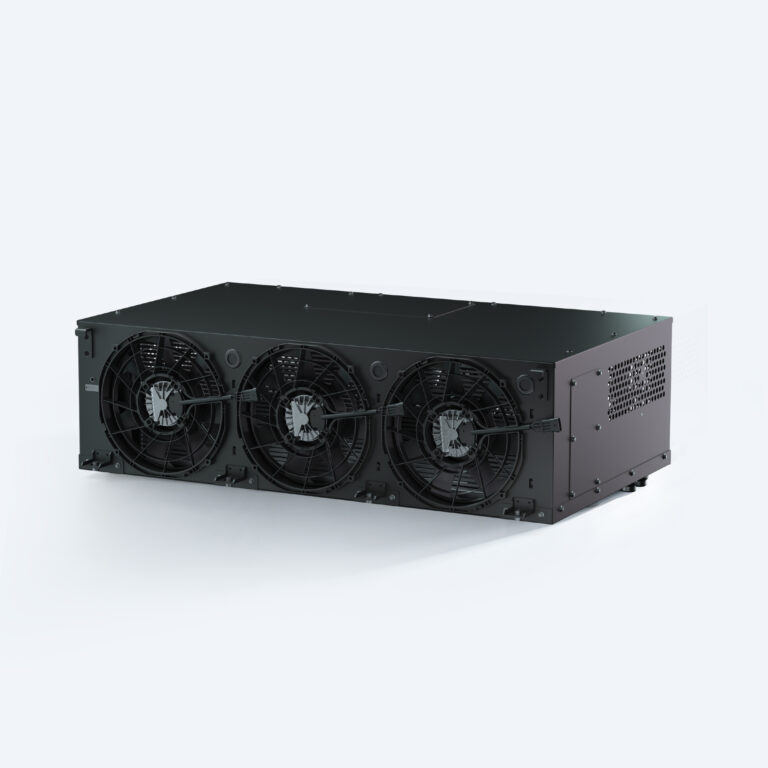
Our Battery Thermal Management System (BTMS) range covers three cooling capacity levels. The data listed in the table below is taken from our official technical specifications.
| Model | Cooling | Heating | Weight | Dimensions (mm) | DC voltage window |
|---|---|---|---|---|---|
| LDC300HA-3KW | 3 kW | Optional (external) | 24 kg | 556 × 465 × 291 | DC 400–750V, with precharge |
| LDC502HA-5KW (single-cool) | 5 kW | Optional | 32 kg | 775 × 594 × 286 | DC 400–860V, with precharge |
| LDC560HA-5KW (cool + heat) | 5 kW | 6 kW PTC, standard | 32 kg | 775 × 594 × 286 | DC 400–860V, with precharge |
| LDC280HA-12KW (cool + heat) | 12 kW | 8 kW PTC, standard | 86 kg | 1179 × 778 × 345 | DC 400–750V |
These four models are based on the same platform specifications: they utilise a 24 V DC low-voltage power supply and support the CAN 2.0 communication protocol at a data rate of 250 kbps; they use R134a refrigerant and a coolant containing 50 per cent ethylene glycol; the system pressure is 3.5 bar; the coefficient of performance (COP) is greater than 2.0; the protection rating is IP67; the operating temperature range is from –35 °C to 60 °C; they come with a 3-year warranty and are designed for a service life of 10 years. Operating noise is below 75 dB.
The voltage range (voltage window) for the 12 kW model (LDC280HA-12KW) is DC 400–750V. Please confirm the upper and lower limits of the voltage range in writing against the current model’s interface specifications before placing an order.
Misconception 1: Selecting a model based solely on vehicle length or battery pack capacity. These are merely reference input parameters, not actual thermal loads. For example, under fast-charging conditions, even a shorter vehicle may have higher cooling requirements than a longer vehicle operating under steady-state conditions.
Misconception 2: Purchasing a model with cooling functionality only, whilst neglecting winter requirements. The 5 kW cooling-only model supports an optional heating function; whilst this is not an issue if the option is included at the time of ordering, it becomes problematic if the need for heating is only realised in January.
Misconception 3: Confirming only one end of the voltage range. If the unit can only match the upper or lower limit of the vehicle’s voltage range, this constitutes an incorrect selection. Please ensure that both the upper and lower limits of the voltage range are confirmed in writing.
The fourth common mistake: overlooking the practicalities of installation and handling. The 12 kW model weighs 86 kg and is 1,179 mm long. Please plan your lifting and installation arrangements well in advance of the unit’s arrival (rather than after it has arrived). The 3 kW model weighs just 24 kg, and its installation requirements are entirely different. Please refer to the dimensional specifications in the table above to verify that the installation space is suitable.
Before placing an order, please confirm the following information in writing:
- The battery voltage range (upper and lower limits) for the specific model
- Continuous and peak thermal loads (rather than considering only the battery pack dimensions)
- Extreme temperature conditions in the vehicle’s actual operating environment
- Heating requirements: cooling only, or both cooling and heating
- Installation space, location and weight restrictions
- Coolant interface parameters and available flow rate at the connection points
- Specific requirements for control interfaces (e.g. CAN 2.0) and the Vehicle Control Unit (VCU)
Information to be provided to us
Please provide the seven items of information listed above, and we will match you with the most suitable equipment (covering the three categories mentioned earlier); should none be applicable, we will inform you accordingly. The quotation provided based on the written information will constitute the solution that can actually be installed. To view our full product range, please visit our Battery Thermal Management Systems page.